


-
 uk
-
 canada
-
 india
uk
canada
india
A practical architecture guide to agent identity, task-scoped permissions, delegation, revocation and accountability across enterprise systems
An AI agent that only drafts a response can often operate with limited access. An agent that updates an ERP record, changes a customer account, approves a refund or delegates work to another agent creates a different problem: the organisation must know which software actor performed the action, whose authority it relied on, what permission was granted for the task, and whether that permission can be withdrawn.
Many early implementations blur three distinct identities: the human who requested work, the agent that performs it, and the service account or credential used to reach a downstream system. When those identities collapse into one shared credential, audit trails lose meaning and permissions become broader than the task requires.
The solution is not to invent an entirely new identity system for AI. It is to apply established identity and access-management principles to agents, while explicitly representing delegation, purpose, scope, duration, downstream audience and accountability. Give the agent its own verifiable workload identity; preserve the requesting principal; grant only task-appropriate authority; enforce it at the resource boundary; and make revocation and investigation part of the design.
The central principle: an agent should be identifiable as an actor, but it should not inherit unlimited authority from the person or system that launched it.
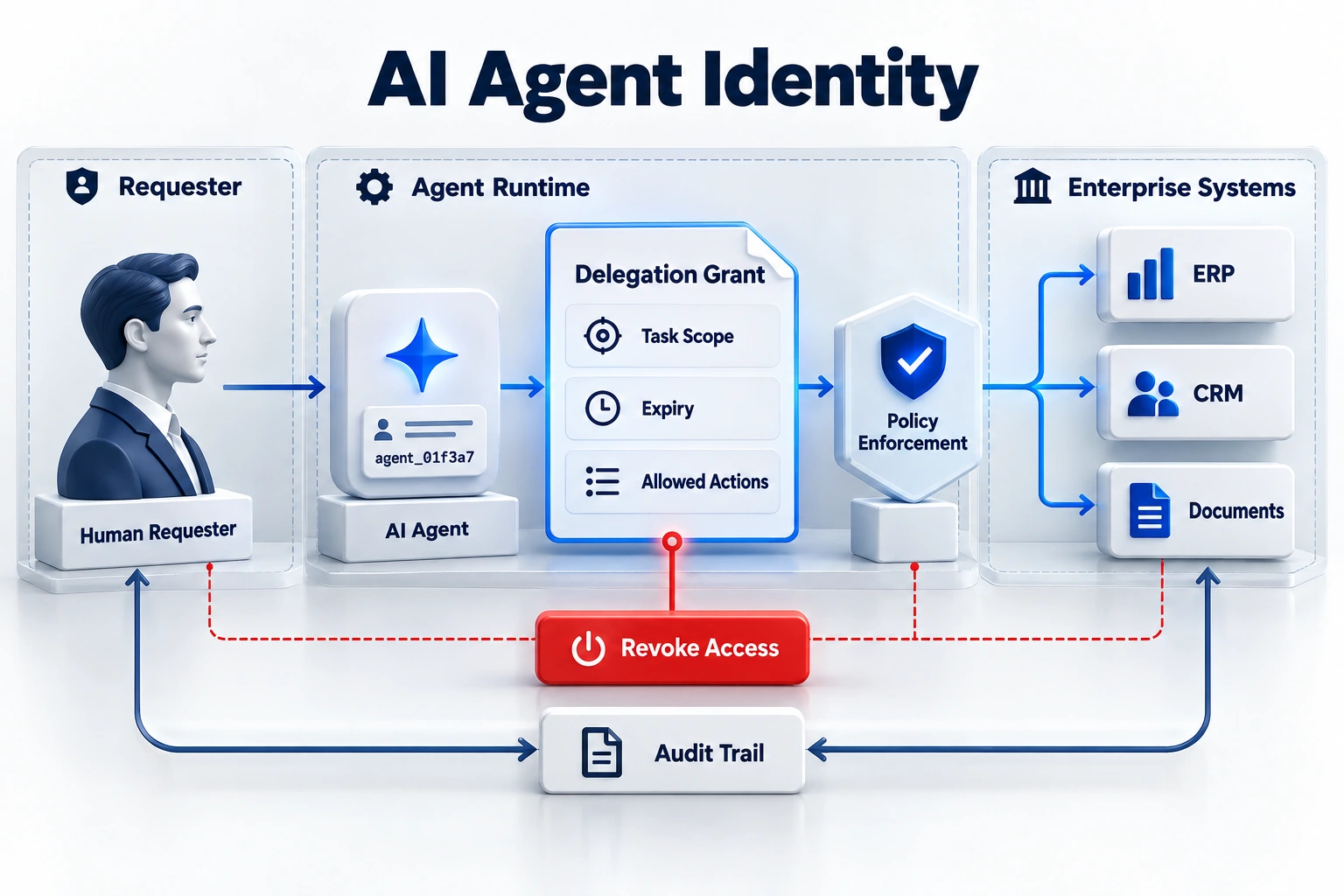
Enterprise AI is moving from assistance toward execution. Agents are being connected to internal applications, business APIs, data platforms and other agents. Gartner’s October 2026 strategic technology trends include AI agent identity, while recent Gartner coverage of agent authorisation highlights delegated authority, runtime enforcement and least privilege as architectural challenges. NIST has also published guidance on applying established identity and authorisation practices to software agents.
The engineering issue is not merely whether an agent can log in. Traditional applications usually have a defined runtime identity and a relatively predictable set of operations. An AI agent may plan a sequence of steps dynamically, select tools at runtime, work for a long period, and request further capabilities as it pursues a broad goal. If its permissions are static and broad, its authority can exceed what any individual step requires.
This makes agent identity a control-plane concern. It connects the agent registry, workload identity, authorisation policy, credential issuance, delegation, audit and emergency revocation. It is not just another field in an agent configuration screen.
Consider a finance employee asking an AI agent to prepare a supplier payment run. The employee is the requester. The AI agent interprets the request and coordinates the work. A workflow service validates invoices. An ERP API records the payment proposal. A payment platform may execute the final transfer.
If every operation uses the employee’s login or a shared finance service account, the system may be unable to answer a basic question: did the employee perform this action directly, did the agent perform it, or did another service act using a credential that both could access?
| Principal | What it represents | Why it matters |
|---|---|---|
| Human/business principal | Person or organisation that requested or owns the work. | Establishes originating authority and accountability. |
| Agent identity | Specific registered agent or runtime workload. | Supports identification, lifecycle management and disablement. |
| Delegated authority | Permission granted for a task or time window. | Limits what the agent may do and under what conditions. |
| Downstream service identity | Credential used to call an ERP, CRM or other resource. | Controls the actual access path and prevents privilege expansion. |
These identities may be represented by different technical mechanisms, but the conceptual separation should remain clear. Authentication identifies a principal. Delegation explains why another principal may act. Authorisation determines whether the requested operation is allowed now.
An agent should not be identified only by its display name, prompt, model name or developer. Those attributes can change and may be copied. A production identity needs a stable identifier tied to a registered workload or deployment, with a known owner, environment, purpose and lifecycle.
A practical agent registry should record:
Do not confuse a registry record with proof of identity. The runtime must present credentials that can be validated, and the resource or identity system must enforce the corresponding policy. “Finance Assistant” is a useful display name; it is not an access-control mechanism.
When an agent acts on behalf of a user, an audit record should preserve two separate facts: who the action is for, and which agent actually executed it. Implementations often distinguish the subject from the actor. The exact representation depends on the identity provider and protocol, but the design goal is consistent.
Suppose a CRM audit log says only “Kavan updated customer 4821.” That record is ambiguous if an AI agent made the change using Kavan’s session. A more useful event says that a registered customer-service agent updated the record on Kavan’s behalf, under a particular task grant, after a specific policy decision.
This distinction supports investigation, compliance and debugging. It also avoids falsely attributing every action to the human who initiated the workflow.
A human may have broad access because their job requires it. An agent working on one task should not automatically inherit that entire permission set. Delegation should attenuate authority: the agent receives a subset of the requester’s permissible authority, narrowed further by task purpose, resource, time, transaction value and risk.
An employee might be allowed to view all open purchase orders and approve purchases up to a threshold. A task to reconcile three invoices should not give an agent unrestricted access to every purchase order or the ability to approve every payment.
| Grant dimension | Example constraint | Design question |
|---|---|---|
| Action | Read invoices; draft payment proposal; no execution. | Which operations are permitted? |
| Resource | Only invoices for suppliers in this task. | Which records or tenants are in scope? |
| Purpose | Reconcile invoices for the October close. | What business objective justifies access? |
| Time | Grant expires after 20 minutes or task completion. | How long does authority remain valid? |
| Value/risk | Payment proposals capped at £5,000; approval above threshold. | What limit or risk condition applies? |
| Delegation | Call approved workflow services; cannot create privileged agents. | May authority be passed onward? |
A request such as “do whatever is needed” expresses intent, not a security policy. The system must convert the task into bounded permissions—or ask for clarification or approval when it cannot.
A useful pattern is an authority envelope: a machine-enforced set of constraints attached to a task. It is not necessarily a new token format. It can be implemented through existing identity-provider claims, OAuth scopes, policy decisions, workflow state and resource-level checks. The important requirement is that constraints survive across the call chain and are enforced by trusted services.
An authority envelope can include:
Avoid treating the agent’s natural-language explanation of its task as the authoritative envelope. A policy service or orchestrator should derive and validate the constraints. The downstream application should still enforce its own business rules.
Static API keys and long-lived bearer tokens are convenient for prototypes, but risky when placed in agent environments that can read files, call tools, generate logs or coordinate other services. A credential can be copied, exposed or reused outside the original task. If it grants broad access, the blast radius can outlast the workflow that needed it.
NIST’s 2026 discussion of agent identity highlights persistent risks: long-lived credentials, overbroad access, local-user impersonation and weak delegation. It points to established approaches such as OAuth 2.0 and workload identity frameworks as foundations, with emerging work exploring more granular authorisation and propagation of transaction context.
These are architectural patterns, not a mandate to adopt one protocol everywhere. Choose mechanisms supported by the identity provider and target systems, then verify the actual token path end to end.
Multi-agent systems introduce a chain-of-delegation problem. A coordinator may ask a research agent to find records, a finance agent to calculate totals, and a workflow agent to create a proposal. If the coordinator can pass its full credentials to every sub-agent, the separation between roles is largely cosmetic.
Every hand-off should answer three questions: what is being delegated, to whom, and with what limits? A sub-agent should receive only the context and authority required for its part of the task. Re-delegation should be explicitly permitted, not assumed.
If a sub-agent cannot prove which authority it received, the safe response is to reject the request or seek a new grant. Trust in the parent agent is not a substitute for validating the child agent’s authority.
Agent permissions are often configured when an integration is created and then forgotten. But agents can run long tasks, hold cached context or tokens, and queue additional work. Disabling an agent in a dashboard does not necessarily invalidate credentials already issued or stop work already queued.
Revocation is not just an IAM setting; it is an operational behaviour. Test it during active workflows, including when an agent is waiting on a remote model or retrying an upstream request.
A valid identity proves that a credential maps to a registered principal under applicable trust rules. It does not prove that the agent’s output is correct, that its prompt is safe, that its tool call is appropriate, or that its software has not been misconfigured.
Do not solve a behavioural risk by simply assigning a stronger identity, and do not use a model’s confidence statement as proof of permission. A trustworthy design combines identity with deterministic enforcement and observable outcomes.
Imagine an organisation introduces an AI procurement assistant. An employee asks it to identify overdue purchase orders, reconcile supplier invoices and prepare payment proposals. The agent can query the ERP, access a document repository and call an approval workflow.
| Scenario | Risky design | Identity-aware design |
|---|---|---|
| Find overdue orders | Agent uses shared ERP administrator account. | Registered workload identity; task grant limits suppliers and read-only order data. |
| Prepare proposal | Agent inherits employee’s full finance permissions. | Scoped grant permits proposal creation only; limits enforced by finance service. |
| Delegate extraction | Parent shares bearer token with document agent. | Child has its own identity and receives only the documents and capability required. |
| Access withdrawn | Agent continues using cached long-lived token. | New grants stop; resource checks reject revoked authority; in-flight work is reconciled. |
| Proposal disputed | Logs show only employee name. | Audit links requester, agents, grant, policy decision, ERP operation and final state. |
The goal is not to make every workflow cumbersome. Low-impact read-only tasks can often run automatically. High-value or irreversible actions can require a second approval or a separate execution identity. The access model should match the risk of the operation.
This is a logical architecture, not a requirement to buy eight separate products. Components can be combined, provided responsibilities remain enforceable and the evidence trail is complete.
Inventory agents: Find first-party agents, vendor-embedded agents, developer-created agents and scheduled automation. Record owners, environments, tools, data access and credentials.
Classify authority: Separate read-only, recommendation, reversible write, high-impact write, and financial or regulated actions.
Establish identity: Assign unique workload identities to production agents and stop sharing human credentials wherever feasible.
Define delegation: For one workflow, specify allowed operations, resources, purpose, expiry, thresholds, approval and re-delegation rules.
Enforce at the resource: Validate identity and delegated authority in the API or domain service that commits the change—not only in the prompt or orchestration UI.
Add evidence and recovery: Correlate actions with requester, agent, grant, policy decision and business outcome; test revocation and incident response.
Expand by measured risk: Use pilot evidence to extend the pattern instead of granting organisation-wide access at launch.
One shared account for every agent. This destroys separation between actors and makes revocation and investigation harder.
The agent uses the employee’s browser session. Convenient local access can let the agent impersonate the user and inherit excess permissions.
A vendor is trusted, so every agent from that vendor is trusted. Vendor trust does not determine appropriate permissions for each agent and workflow.
A role is granted once and never reviewed. Capabilities change; standing permissions can become excessive or orphaned.
A parent agent passes its token to a child agent. The child may gain authority unrelated to its task; use explicit, bounded delegation.
Disabling the agent is assumed to revoke everything. Issued tokens, queued work and in-flight operations may persist unless revocation is designed and tested.
AI agents are becoming active participants in enterprise workflows. As they move across applications and delegate work to other services or agents, traditional assumptions about user sessions and shared service accounts become increasingly fragile.
The answer is not to treat an agent as a human, nor to create an isolated identity stack for every new AI framework. It is to build on established identity and authorisation practices, while making agent identity, delegated authority, task scope, expiry, revocation and audit explicit.
A production system should be able to answer, for every consequential operation: which agent acted, on whose behalf, under what grant, against which resource, under which policy, and with what outcome?
If those questions cannot be answered reliably, the organisation has delegated execution without fully engineering accountability.


