


-
 uk
-
 canada
-
 india
uk
canada
india
An AI agent can complete a task, return a convincing answer and still be wrong in a way that matters.
It might query the wrong date range, update the wrong customer record, repeat a payment-related action, misread an exception in a policy, or continue a workflow after one of its assumptions has become invalid. The system may report no software exception. Every API may have returned a successful status code. Yet the business outcome is incorrect.
This is the reliability challenge of agentic AI: success cannot be measured only by whether the model produced an answer or whether the workflow ran without crashing.
Enterprise agents combine model decisions with context, tools, APIs, data permissions, orchestration and external state. Failures can emerge from interactions between components rather than from one defective component. A 2026 study on AI-agent reliability argues that accuracy alone is insufficient, highlighting consistency, robustness, predictability and safety as separate dimensions. Microsoft Research's AgentRx work similarly focuses on locating the critical failure step in long agent trajectories. Sources: https://proceedings.mlr.press/v306/rabanser26a.html and https://www.microsoft.com/en-us/research/blog/systematic-debugging-for-ai-agents-introducing-the-agentrx-framework/
The engineering objective is not to make an agent autonomous at any cost. It is to make autonomy bounded, observable, recoverable and proportionate to the consequences of its actions.
This article presents a practical reliability-engineering approach for enterprise AI agents, borrowing from distributed systems, fault handling, software testing and safety engineering.
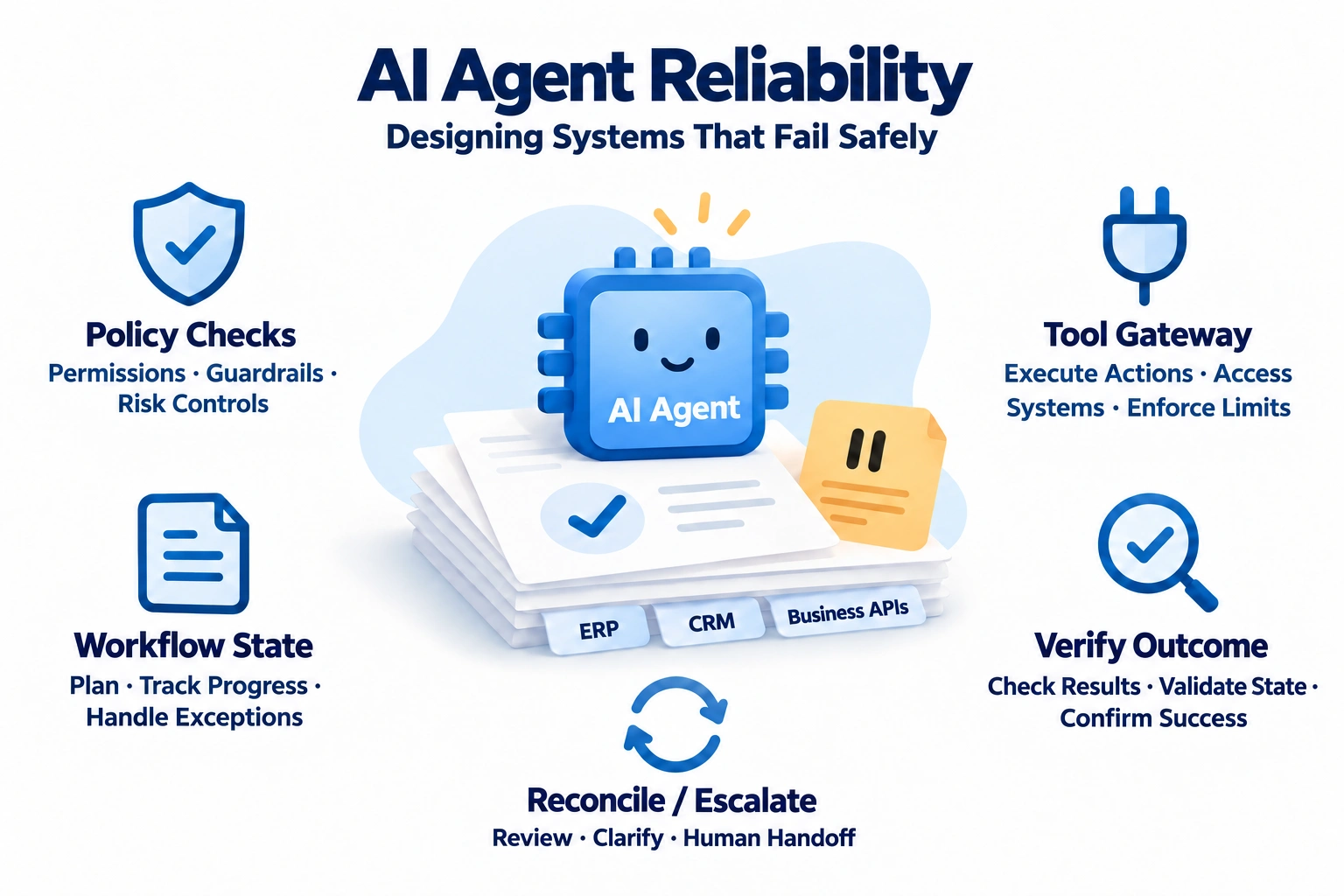
For a chatbot, teams may focus on answer quality, latency and user satisfaction. For an agent that can modify business systems, those metrics are not enough.
| Dimension | Reliability question | Example |
|---|---|---|
| Correctness | Did it achieve the intended business outcome? | Order cancelled only when eligible. |
| Consistency | Does it behave similarly on equivalent requests? | Equivalent cases receive equivalent policy treatment. |
| Robustness | Does it handle variation and incomplete information? | Ambiguous order number triggers clarification. |
| Predictability | Does it fail within known boundaries? | Failed ERP call stops the workflow instead of guessing. |
| Safety | Are harmful or unauthorised actions prevented? | Refund above threshold requires approval. |
| Recoverability | Can the workflow resume or compensate safely? | Timeout does not trigger duplicate refund. |
A single overall success rate can hide dangerous failure modes. An agent that succeeds on 95% of tasks but occasionally makes an irreversible financial change may be unacceptable for that use case.
Before deciding how autonomous an agent should be, define what it is designed and authorised to do. This operating envelope should be explicit enough to test.
| Boundary | Questions to define |
|---|---|
| Task scope | Which requests are in scope, and which must be rejected or escalated? |
| Data scope | Which records, tenants and fields may it access? |
| Tool scope | Which APIs and actions are available? |
| Transaction limits | What values, quantities or rates can it change? |
| Evidence threshold | What information must be verified before acting? |
| Approval threshold | Which actions require human confirmation? |
| Time and retry limits | How long may it run, and how many retries are allowed? |
| Stop conditions | What signals require it to pause or terminate? |
These boundaries should be enforced by the application, API gateway, policy engine and tool implementations wherever possible.
A business invariant is a rule that must remain true regardless of what the model says. Examples:
These rules should be enforced with deterministic validation, database constraints, authorization checks, transaction boundaries and server-side policy logic. A system prompt that says 'do not issue duplicate refunds' is not a reliable substitute for idempotency and transaction controls.
The model can interpret a request and recommend an action. The application should validate whether that action is legal in the current business state.
A common implementation mistake is to place an entire business process into a large prompt and ask the agent to manage it from memory. That makes state transitions hard to validate and failures difficult to recover from.
For consequential workflows, represent the process explicitly:
RECEIVED
  ↓
IDENTITY & ORDER VERIFIED
  ↓
ELIGIBILITY CHECKED ──► NOT ELIGIBLE: EXPLAIN / ESCALATE
  ↓
APPROVAL REQUIRED?
  ├─ YES → PENDING HUMAN APPROVAL
  └─ NO  → READY TO EXECUTE
                  ↓
          IDEMPOTENT ACTION
                  ↓
          VERIFY SYSTEM STATE
           ├─ CONFIRMED → COMPLETE
           └─ UNKNOWN → RECONCILE / ESCALATE
The agent may interpret the request, gather evidence and propose the next step. The state machine controls the legal sequence and prevents uncertain model decisions from bypassing required checks.
When an agent calls an ERP, CRM, payment gateway or shipping API, it interacts with distributed systems that can time out, partially fail, return stale data or process a request even when the caller never receives the response.
The unknown-outcome case is critical. If a payment or refund request times out, query the system of record before retrying. Blindly repeating the operation can create duplicate transactions.
| Failure type | Safer response |
|---|---|
| Transient read timeout | Retry with bounded backoff if safe. |
| Rate limit | Respect provider guidance and pause. |
| Invalid tool input | Correct or validate input; do not repeat unchanged. |
| Permission denied | Stop and explain or escalate. |
| Unknown transaction outcome | Query the system of record before retrying. |
| Stale business state | Refresh state and re-evaluate. |
| Repeated model/tool loop | Apply a step limit and terminate clearly. |
| Conflicting evidence | Pause and request resolution. |
Recovery logic should be selected according to the failure mode, not implemented as one universal retry loop.
Long-running agents may span multiple API calls, human approvals, asynchronous jobs and external systems. The workflow should not depend on the model remembering everything in its context window.
With durable state, a workflow can resume after a service restart or approval without repeating earlier actions. It also creates an audit trail that is easier to investigate than a transcript alone.
Not every agent action deserves the same level of control. Match autonomy to impact and reversibility.
| Action class | Examples | Control pattern |
|---|---|---|
| Low impact / reversible | Search a document, summarise an order | Automated with normal validation |
| Moderate impact | Draft CRM update, prepare purchase request | Preview, validation and optional review |
| High impact | Issue refund, change supplier bank detail | Strong policy checks and approval |
| Irreversible / safety-critical | Delete critical data, release high-value payment | Human authorisation, dual control or disallow automation |
Human-in-the-loop should not be a vague checkbox. Present the proposed action, supporting evidence, expected effect and relevant uncertainty, then record the decision.
An agent demo usually showcases the best-case journey. Production readiness requires testing the situations most likely to expose weak boundaries.
Microsoft Research's AgentRx work is a useful signal: diagnosing the first critical failure in a trajectory is more actionable than merely labelling the final answer incorrect. Read: https://www.microsoft.com/en-us/research/blog/systematic-debugging-for-ai-agents-introducing-the-agentrx-framework/
An agent can pass a test once and fail on a near-identical request later. Test evidence should include repeated runs, perturbations and operational conditions, not just a single benchmark score.
| Metric | What it tells you |
|---|---|
| Task completion rate | How often the intended outcome is achieved |
| Correct-action rate | How often executed actions are valid and authorised |
| Consistency | Variation across equivalent requests and repeated runs |
| Recovery rate | How often failures resolve without unsafe duplication |
| Escalation quality | Whether uncertain/high-impact cases reach the right reviewer |
| Critical failure rate | Frequency of failures breaching a business invariant |
| Boundedness | Whether the agent stops within defined step, cost and time limits |
| Outcome verification rate | How often success is confirmed against the system of record |
The most important metrics depend on the use case. For an order-management agent, duplicate-action rate, state correctness and confirmed completion may matter much more than answer fluency.
AI observability, covered in Blog 9, provides the evidence reliability engineering needs to diagnose where a workflow first went wrong.
Logs should be privacy-aware: store enough evidence to diagnose behaviour, but redact or minimise sensitive data. For high-impact actions, the trace should establish what happened and which policy authorised it.
A stop mechanism is not merely a prompt instruction to 'stop if uncertain'.
NIST's 2026 guidance on agent identity and authorization reinforces the need to apply established identity and access-control practices to software agents. Agents should be treated as identifiable actors with scoped authority, not unrestricted extensions of a user's session. Sources: https://www.nist.gov/blogs/cybersecurity-insights/back-future-why-agentic-ai-needs-strong-identity-foundation and https://www.nist.gov/news-events/news/2026/02/new-concept-paper-identity-and-authority-software-agents
Imagine an AI agent that can answer order questions, request cancellation, initiate refunds and update a CRM.
A customer asks to cancel an order. The agent retrieves the order, sees a status that appears eligible and requests cancellation. However, the order is dispatched between the initial lookup and the cancellation request.
A fragile implementation trusts the earlier context and proceeds. A reliable implementation revalidates order state at the point of action. The cancellation API enforces the rule server-side. If the result is uncertain because of a timeout, the workflow checks the system of record before deciding what to do next.
The model remains useful for interpreting intent and explaining the outcome. Deterministic controls preserve business correctness. Use AI for flexible interpretation; use explicit software controls for authority, invariants and side effects.
USER / BUSINESS EVENT
        │
        ▼
TASK INTERPRETATION (AI)
        │
        ▼
POLICY + PERMISSION CHECKS ──► DENY / CLARIFY / APPROVAL
        │
        ▼
DURABLE WORKFLOW STATE MACHINE
        ├──► CONTEXT / RETRIEVAL
        ├──► MODEL DECISION
        └──► TOOL GATEWAY
                    │
          VALIDATE + AUTHORISE
                    │
                    ▼
          ENTERPRISE API / SYSTEM
                    │
                    ▼
          VERIFY OUTCOME / RECONCILE
                    │
             ┌──────┴──────┐
             ▼             ▼
          COMPLETE     RECOVER / ESCALATE
             └──────┬──────┘
                    ▼
         TRACE + EVALUATION + AUDIT
The architecture separates model decisions from the authority to execute business actions. It treats recovery, verification and audit as first-class workflow components.
| Capability | Core question |
|---|---|
| AI Governance — Blog 7 | What should the system be allowed to do? |
| AI-Native Architecture — Blog 8 | How should the system be designed? |
| AI Observability — Blog 9 | What actually happened in production? |
| Context Engineering — Blog 10 | What information did the AI receive? |
| Agent Reliability Engineering — Blog 11 | How do we keep failures bounded and recover safely? |
These are not separate buzzwords. They form a practical engineering system: govern authority, design the architecture, assemble the right context, observe execution and engineer recovery.
Complex software systems fail. Networks time out, data changes, dependencies become unavailable and assumptions turn out to be wrong. AI agents add uncertainty to that reality, but they do not remove the need for established engineering discipline.
The goal is not to promise an agent that never fails. It is to build an agent whose failure modes are understood, whose authority is limited, whose actions are verified, whose state can be recovered and whose mistakes cannot easily cascade into larger business damage.
For enterprise AI, reliability is not a prompt-writing exercise. It is an end-to-end property of the system — spanning models, context, workflow state, APIs, permissions, testing, monitoring and recovery.
The strongest agent is not necessarily the one that acts most autonomously. It is the one that knows when to act, how to verify the result and when to stop.
Moving an AI agent from proof of concept into a dependable business workflow requires more than a model and a prompt. It needs clear permissions, reliable integrations, durable workflow logic, outcome verification and operational visibility.
Space Stem helps businesses design and integrate AI-powered applications with ERP, CRM, e-commerce and other enterprise systems.
If you are evaluating an AI agent for a real business process, talk to our team about the architecture and controls needed to make it production-ready.


