Artificial Intelligence (AI) is rapidly becoming one of the most influential technologies in modern software engineering. While headlines often focus on AI writing code or replacing developers, the reality is far more nuanced—and far more interesting.
The true value of AI lies in its ability to enhance software engineering teams by automating repetitive tasks, accelerating development workflows, improving code quality, and enabling developers to spend more time solving complex business problems.
For organizations investing in custom software development, AI is changing not just how applications are built, but how quickly businesses can innovate, respond to market demands, and deliver digital solutions.
However, AI is not a replacement for experienced software engineers. Enterprise applications still require thoughtful architecture, secure integrations, scalable design, rigorous testing, and a deep understanding of business processes. AI simply enables engineering teams to accomplish these tasks more efficiently.
In this article, we explore ten practical ways AI is transforming custom software development, why businesses should embrace AI-assisted engineering, and how experienced development teams can combine AI with sound engineering practices to deliver better software.

Software development has always evolved alongside technological innovation.
From procedural programming to object-oriented design, from Agile methodologies to DevOps and cloud-native architectures, each advancement has helped engineering teams build better software more efficiently.
Artificial Intelligence represents the next significant evolution.
Unlike previous technological shifts, AI is not introducing a new programming language or framework. Instead, it is augmenting the software development process itself.
Today's AI-powered development tools can understand large codebases, generate repetitive code, explain unfamiliar implementations, suggest improvements, identify potential defects, assist with testing, and even help developers navigate complex architectures.
This shift is fundamentally changing the way enterprise software is designed, developed, tested, and maintained.
For businesses, this means:
Organizations that adopt AI-assisted software development responsibly are gaining a competitive advantage—not because AI replaces engineers, but because it empowers them.
With the rapid growth of SaaS platforms, low-code solutions, and AI-powered development tools, some organizations question whether custom software is still worth the investment.
The answer is unequivocally yes.
Every business operates differently. Whether it's unique workflows, specialized compliance requirements, proprietary processes, or competitive differentiators, off-the-shelf software often requires businesses to adapt their operations to fit the software.
Custom software takes the opposite approach.
It is designed around the business itself, enabling organizations to optimize processes, integrate existing systems, and create experiences tailored to their customers and employees.
AI doesn't change this need—it amplifies it.
By accelerating development and reducing repetitive engineering tasks, AI allows organizations to build sophisticated, business-specific applications more efficiently than ever before.
One of the biggest misconceptions surrounding AI is that it will eventually replace software developers.
While AI has become remarkably capable at generating code, it lacks many of the qualities that define successful software engineering.
AI cannot:
These responsibilities remain firmly in the hands of experienced software professionals.
Think of AI as an exceptionally capable engineering assistant rather than an autonomous software architect.
It can recommend solutions, automate repetitive tasks, and increase developer productivity—but it still relies on human expertise to guide, validate, and refine its output.
The most successful software projects today combine the strengths of both.
The most visible impact of AI is its ability to accelerate development.
Enterprise applications contain a significant amount of repetitive implementation work.
Developers routinely create:
While essential, these tasks consume valuable engineering time.
AI can generate much of this foundational code in seconds, allowing developers to focus on architecture, business rules, integrations, and user experience.
For businesses, this translates into:
This acceleration doesn't reduce engineering quality. Instead, it shifts developer effort toward solving higher-value problems.
Contrary to popular belief, writing code is only one part of software development.
The real challenge lies in understanding the business.
Questions such as:
These are business questions before they become technical ones.
AI cannot answer them.
However, by reducing repetitive coding tasks, AI gives developers more time to collaborate with stakeholders, refine requirements, and design solutions that align with business objectives.
This leads to software that is not only delivered faster but also delivers greater business value.
Maintaining a large enterprise codebase is a complex task.
As applications grow, developers must ensure consistency, readability, and long-term maintainability across thousands—or even millions—of lines of code.
AI acts as an intelligent code review assistant by helping identify:
Rather than replacing peer reviews, AI complements them.
Experienced engineers still evaluate architecture, security, performance, and business correctness. AI simply provides another layer of intelligent analysis that helps teams maintain cleaner, more maintainable codebases.
Over time, this contributes to reduced technical debt and makes future enhancements easier to implement.
For many organizations, testing consumes nearly as much effort as software development itself. Enterprise applications often require hundreds—or even thousands—of test cases covering functional requirements, integrations, security, performance, and regression scenarios.
Traditionally, QA engineers spend considerable time creating test cases, executing repetitive regression tests, documenting defects, and verifying fixes. While automated testing frameworks have significantly improved efficiency, building and maintaining those frameworks still demands ongoing effort.
AI is introducing a new level of intelligence into software testing by assisting QA teams throughout the testing lifecycle.
Today, AI can help development teams:
This doesn't remove the need for QA engineers. Instead, it enables them to focus on validating business processes, user experience, security, and compliance—areas where human judgment remains essential.
For enterprise software handling financial transactions, healthcare data, logistics, or ERP integrations, thorough human validation is irreplaceable. AI simply accelerates the process and improves overall testing efficiency.
Debugging has always been one of the most time-consuming aspects of software development.
A seemingly simple issue can require hours of investigation across multiple services, APIs, databases, logs, and configuration files before the actual cause is identified.
AI-assisted development significantly reduces this effort.
Modern AI tools can analyze stack traces, interpret exception messages, identify likely root causes, explain unfamiliar code, and even suggest potential fixes based on context.
Consider a scenario where an ERP integration suddenly stops synchronizing order data.
Without AI assistance, a developer might manually inspect:
AI can help narrow the investigation by highlighting the most probable failure points, enabling developers to resolve issues much faster.
For businesses, this means reduced downtime, quicker incident resolution, and improved system reliability.
Documentation is one of the most overlooked aspects of software development.
Not because teams underestimate its importance, but because project timelines often prioritize feature delivery over documentation.
The result is familiar to many organizations:
AI is helping address this challenge by generating meaningful documentation throughout the development process.
It can assist with:
Rather than starting from a blank page, engineering teams receive a structured draft that can be reviewed and refined.
This significantly reduces documentation effort while improving consistency across projects.
Well-documented software is easier to maintain, easier to scale, and easier to hand over between teams.
Many businesses continue to rely on software systems that were built years—or even decades—ago.
These applications often power critical business processes but present several challenges:
Completely replacing these systems is rarely practical. Instead, organizations typically modernize them incrementally.
AI plays an increasingly valuable role in this process.
It can help developers:
For example, migrating a legacy ASP.NET MVC application to ASP.NET Core traditionally requires extensive code analysis before any development begins.
AI accelerates that discovery phase by helping engineers understand relationships between controllers, services, repositories, and data models much more quickly.
However, modernization still requires experienced architects to determine the right migration strategy, validate business logic, and ensure long-term maintainability.
Modern software development is a collaborative effort involving multiple disciplines.
A typical enterprise project may include:
Clear communication between these roles is essential to project success.
AI is helping improve collaboration by assisting with tasks such as:
These capabilities reduce administrative overhead and help teams spend more time delivering value.
Importantly, AI enhances collaboration—it does not replace it.
Successful software projects continue to depend on effective communication, shared understanding, and cross-functional teamwork.
Traditional Development vs AI-Assisted Development
| Aspect | Traditional Development | AI-Assisted Development |
|---|---|---|
| Code Generation | Fully manual | AI-assisted with developer review |
| Boilerplate Code | Manual creation | Automated generation |
| Debugging | Manual investigation | AI-supported root cause analysis |
| Documentation | Often delayed | Continuously generated and refined |
| Test Case Creation | Manual | AI-assisted recommendations |
| Knowledge Sharing | Team dependent | AI-supported documentation and explanations |
| Development Speed | Standard | Significantly accelerated |
| Code Reviews | Human only | Human review enhanced by AI insights |
| Architecture Decisions | Human-driven | Human-driven with AI recommendations |
| Final Responsibility | Development team | Development team |
This comparison reinforces an important principle:
AI changes how software is developed—it does not change who is responsible for delivering secure, scalable, and reliable enterprise applications.
A Practical Enterprise Example
Imagine a distribution company planning to build a centralized operations platform that integrates data from:
In a traditional development process, engineers spend considerable time on foundational work such as creating project scaffolding, implementing CRUD operations, configuring APIs, setting up authentication, writing documentation, and preparing initial test cases.
With AI-assisted development, much of this repetitive work can be accelerated.
This enables the engineering team to focus on higher-value activities, including:
The result is not simply a faster project. It is a more focused engineering effort, where developers spend more time solving business challenges and less time on repetitive implementation tasks.
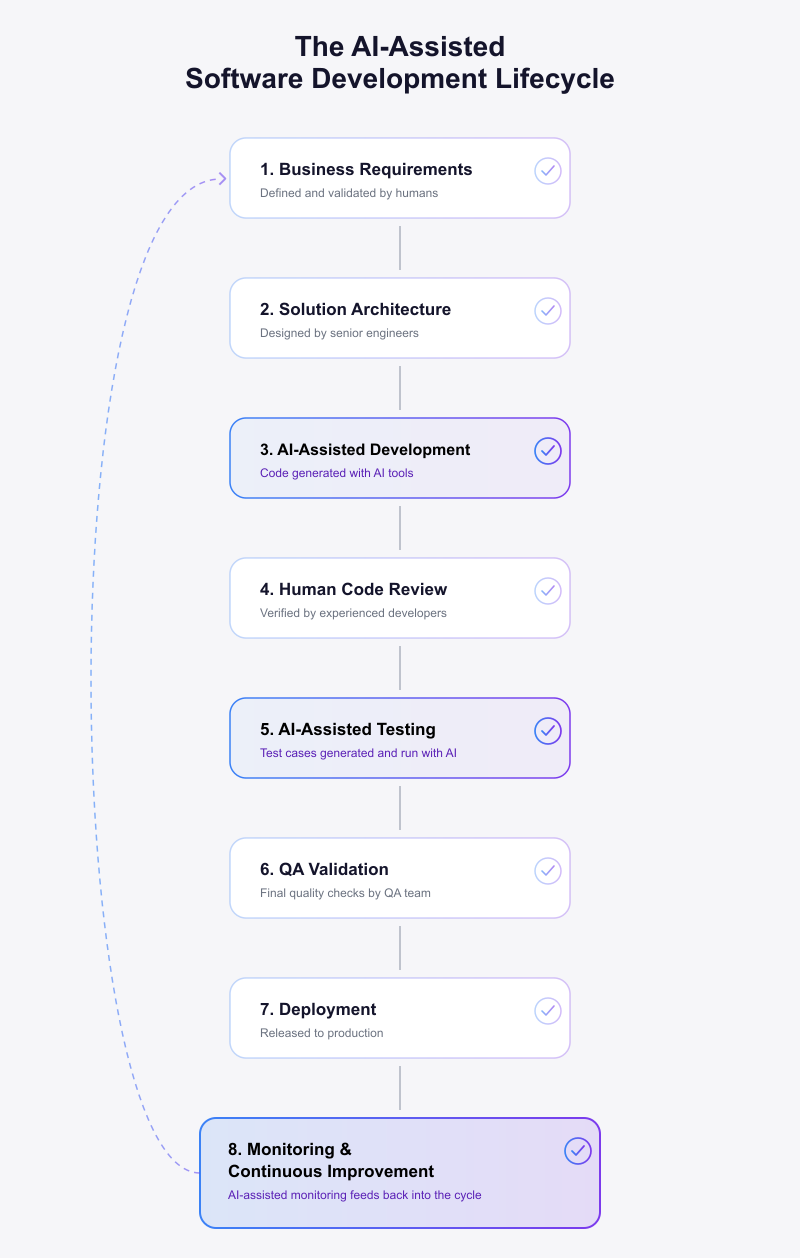
Software architecture is one of the most critical aspects of enterprise application development. Decisions made during the architecture phase influence scalability, maintainability, security, performance, and future extensibility.
Despite the rapid advancement of AI, architecture remains a fundamentally human responsibility.
Why?
Because architectural decisions involve much more than writing code. They require balancing technical constraints with business objectives, evaluating trade-offs, understanding organizational priorities, planning for future growth, and anticipating operational challenges.
However, AI is becoming an invaluable assistant during this process.
Experienced architects increasingly use AI to:
For example, when designing a high-volume ERP-integrated platform, an architect must determine:
AI can provide insights and recommendations, but the final decisions depend on business requirements, budget, operational complexity, and long-term vision.
This is where experienced software architects continue to provide irreplaceable value.
Perhaps the greatest transformation AI brings is not faster coding—it is faster innovation.
Historically, organizations often hesitated to pursue new ideas because validating them required significant investment in time and development resources.
Today, AI-assisted engineering dramatically lowers that barrier.
Development teams can:
This shorter feedback loop enables organizations to experiment confidently while reducing the risk associated with innovation.
Whether developing an ERP module, a customer portal, a warehouse management system, or an internal business application, AI helps teams move from concept to validation much faster.
The result is an organization that can adapt more quickly to changing customer expectations and market conditions.
Common Misconceptions About AI in Software Development
As AI becomes more prevalent, several misconceptions continue to shape discussions around its role in software engineering.
Let's address some of the most common ones.
| Myth | Reality |
|---|---|
| AI will replace software developers. | AI enhances developer productivity but still relies on experienced engineers for architecture, business logic, security, and decision-making. |
| AI-generated code is production-ready. | AI-generated code requires review, validation, testing, and optimization before production use. |
| AI understands business requirements. | AI processes prompts but does not truly understand organizational goals, stakeholder expectations, or domain-specific nuances. |
| AI eliminates software testing. | AI assists with testing but cannot replace comprehensive validation performed by QA engineers. |
| AI guarantees better software. | Quality depends on engineering expertise, design decisions, testing, and governance—not AI alone. |
Understanding these realities helps organizations adopt AI responsibly while setting realistic expectations.
Organizations considering AI-assisted software development should view AI as part of a broader engineering strategy rather than a standalone solution.
Some best practices include:
Identify where AI can create the greatest value, such as accelerating development, improving testing, or enhancing documentation.
Every AI-generated output should be reviewed by experienced developers before being incorporated into production systems.
AI delivers the greatest benefits when combined with strong software engineering practices, including clean architecture, secure coding standards, automated testing, and peer reviews.
Development teams should establish clear governance policies regarding the use of proprietary source code, confidential business information, and client data within AI-assisted workflows.
AI capabilities evolve rapidly. Encouraging continuous learning ensures engineering teams remain productive while adopting new technologies responsibly.
Artificial Intelligence is still in the early stages of transforming software engineering.
Over the next few years, we can expect AI to become even more integrated into the software development lifecycle.
Future capabilities may include:
While these advancements will further increase productivity, they are unlikely to replace the need for experienced software engineers.
Instead, software development will become increasingly collaborative, with AI handling repetitive tasks while engineers focus on creativity, architecture, innovation, and business problem-solving.
Artificial Intelligence is transforming custom software development in meaningful and practical ways.
It is helping organizations accelerate delivery, improve code quality, streamline testing, modernize legacy systems, enhance collaboration, and innovate more rapidly than ever before.
However, the true power of AI does not lie in replacing software engineers.
Its greatest value lies in enabling experienced development teams to focus on what matters most—designing scalable architectures, solving complex business challenges, delivering secure enterprise applications, and creating long-term value for clients.
Organizations that combine skilled engineers with AI-assisted development practices will be well positioned to deliver software that is faster to market, easier to maintain, and better aligned with evolving business needs.
At Space Stem, we see AI not as a shortcut, but as a catalyst for engineering excellence. By integrating AI thoughtfully into our development processes, we help clients accelerate digital transformation while maintaining the quality, scalability, and reliability expected of enterprise software.
Whether you're building a custom ERP solution, integrating business systems, modernizing legacy applications, or developing enterprise software from the ground up, Space Stem combines experienced engineers with AI-assisted development practices to deliver scalable, secure, and future-ready solutions.
Get in touch with our team to discuss how we can help transform your software ideas into business outcomes.
