Every growing business eventually faces a technology decision that sounds deceptively simple:
Should we buy software that already exists, or should we build something specifically for our business?
The answer isn’t always obvious.
Off-the-shelf software can be faster to deploy, easier to budget for, and supported by an established vendor.
Custom software can provide greater flexibility, deeper integrations, better alignment with business processes, and more control over the long term.
Neither option is automatically better.
The right decision depends on the business.
A small company with standard accounting requirements probably doesn’t need to build its own accounting platform.
A large organization operating a highly specialized fulfilment process across ERP, e-commerce, inventory, warehouse, and customer systems may eventually find that forcing its operations into generic software creates more problems than it solves.
The important question isn’t:
“Is custom software better?”
It is:
“Which approach creates the best business outcome for our specific requirements?”
This article provides a practical framework for answering that question.
The decision between custom and off-the-shelf software should be based on business requirements rather than technology preference.
The most important consideration is Total Cost of Ownership (TCO).
The cheapest software to purchase is not necessarily the cheapest software to operate.
Likewise, custom software isn’t automatically expensive if it eliminates years of licensing, manual work, integration problems, and operational inefficiencies.
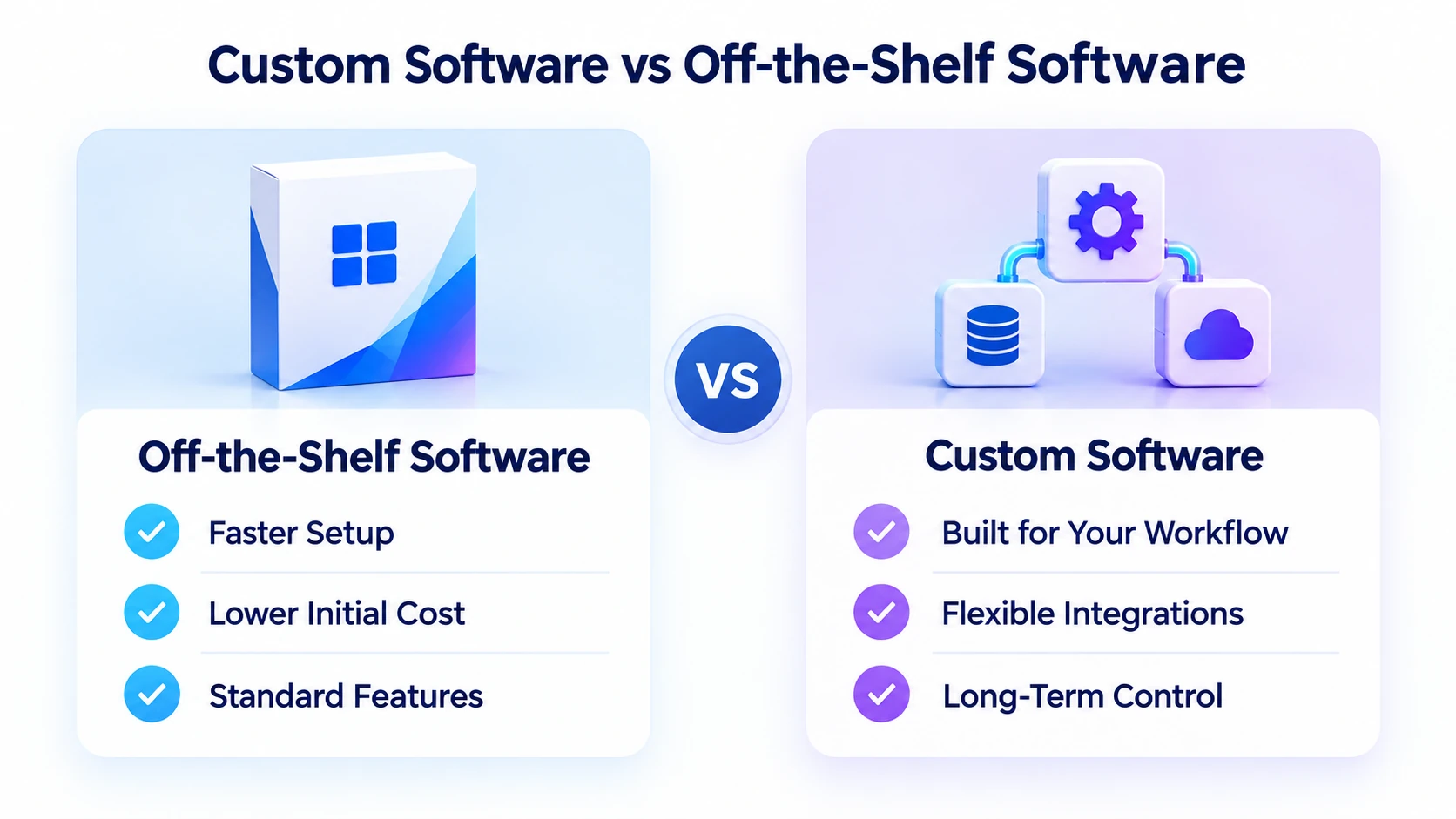
Off-the-shelf software is a commercially available product designed to serve the needs of a broad market.
Examples include:
The fundamental advantage is that somebody else has already built the product.
Instead of starting from zero, a business can subscribe, configure the system, train employees, and begin using it.
This makes off-the-shelf software extremely attractive for common business requirements.
Custom software is designed and developed specifically for an organization’s requirements.
It can be built to support:
For example, a business may need a platform that connects:
ERP
 │
 ├── Inventory
 │
 ├── Orders
 │
 ├── Customers
 │
 └── Finance
       │
       ▼
 E-Commerce
       │
       ▼
 Warehouse
       │
       ▼
 Customer Portal
       │
       ▼
 Real-Time Dashboard
If existing products cannot support the workflow efficiently, custom development may become a strategic option.
Before comparing costs, ask a more fundamental question:
Is this capability strategically important to the business?
Consider two scenarios.
Payroll processing is essential, but it usually isn’t the company’s competitive differentiator.
Using an established payroll platform makes sense for many businesses.
Imagine a business with a highly optimized order-processing system that allows it to fulfil orders significantly faster than competitors.
That workflow may represent genuine competitive value.
Replacing it with generic software simply because the software already exists could actually reduce the company’s advantage.
Software that supports a commodity process should often be bought.
Software that creates competitive differentiation may be worth building.
This is one of the most useful principles in the entire build-vs-buy decision.
One of the easiest mistakes is comparing software products by checking feature lists.
Product A has 150 features.
Product B has 200.
Product C has 300.
That doesn’t tell you which product is right.
Instead, identify the business workflows that matter.
For example:
“We need order management.”
is too broad.
A better requirement might be:
“When a customer places an order, the system must validate inventory, apply customer-specific pricing, reserve stock, send the order to the ERP, trigger warehouse fulfilment, and provide real-time status to the customer.”
Now the software decision becomes much clearer.
Can an off-the-shelf system support that workflow?
If yes, great.
If it can only support it through extensive customization, integrations, manual workarounds, or third-party tools, the economics may change.
One of the biggest advantages of buying software is speed.
A mature SaaS platform may allow a business to implement a capability in weeks or even days.
Custom software typically requires:
If the requirement is standard and time-sensitive, off-the-shelf software often wins.
However, speed should be measured beyond the initial deployment.
A system that takes two weeks to implement but requires six months of workarounds may not actually be faster.
Off-the-shelf software operates within the boundaries defined by its vendor.
The vendor controls:
That isn’t necessarily a problem.
But it can become one when the software becomes critical to your business.
With custom software, the organization has significantly greater control over:
This control can be particularly valuable for businesses whose processes are evolving rapidly.
Integration is one of the most important factors in a build-vs-buy decision.
Modern businesses rarely operate with one application.
They may use:
An off-the-shelf application may technically support integrations but still require significant effort to make those integrations work correctly.
Consider:
E-Commerce
     │
     ▼
   ERP
     │
 ┌───┼────┐
 ▼   ▼    ▼
CRM WMS Payment
     │
     ▼
 Dashboard
If your business depends heavily on these connections, integration architecture becomes a major part of the software decision.
A product’s integration capabilities should be evaluated based on your actual workflows, not merely the number of APIs advertised on its website.
This is where many businesses underestimate the cost of off-the-shelf software.
Suppose employees need to perform five manual steps because the software cannot support a particular workflow.
Each step may seem insignificant.
But multiply that by:
The operational cost can become substantial.
For example:
Generic Software
      ↓
Manual Export
      ↓
Excel Processing
      ↓
Data Validation
      ↓
Manual Upload
      ↓
ERP Update
A custom workflow might replace this with:
Business Transaction
        ↓
Automated Integration
        ↓
ERP
The value of custom software isn’t simply the feature itself.
It can be the elimination of operational friction.
This is perhaps the most important financial consideration.
A software decision should consider the complete cost over its expected lifetime.
Consider:
Consider:
A useful comparison is:
| Cost Factor | Off-the-Shelf | Custom |
|---|---|---|
| Initial cost | Usually lower | Usually higher |
| Deployment speed | Usually faster | Usually slower |
| Customization | Limited to extensive | Very high |
| Licensing | Recurring | Depends on architecture |
| Vendor dependency | High | Lower |
| Integration flexibility | Varies | High |
| Business-specific workflows | Limited/varies | Excellent |
| Long-term control | Limited | High |
| Scalability control | Vendor-dependent | Organization-controlled |
| Maintenance responsibility | Vendor + customer | Customer/development partner |
The important point is that initial cost is only one part of the financial equation.
Vendor dependency isn’t automatically bad.
Strong vendors provide:
But organizations should understand what happens if:
Custom software doesn’t eliminate all dependencies, but it can provide greater control over the application’s roadmap and underlying architecture.
Security requirements vary significantly between businesses.
Some organizations have relatively straightforward requirements.
Others operate in environments involving:
Off-the-shelf vendors may provide strong security capabilities and certifications.
In many cases, using an established SaaS provider can actually be more secure than attempting to build everything internally.
But organizations with highly specific security or data-control requirements may need greater control over architecture, infrastructure, and data flows.
The correct approach is to evaluate the actual requirements rather than assuming custom is automatically more secure.
Off-the-shelf platforms can scale extremely well.
Many SaaS products serve millions of users.
So custom software should never be chosen simply because:
“We need scalability.”
The real question is:
Does the software scale in the way our business needs?
For example, your business may require:
If the commercial product cannot accommodate those requirements without significant compromises, custom architecture may provide greater flexibility.
A powerful way to think about custom software is this:
The software isn’t the asset. The business capability it enables is the asset.
Imagine two logistics companies.
Both use warehouse management software.
Company A uses a generic workflow.
Company B has developed a highly optimized process that reduces fulfilment time by 30%.
For Company B, the software supporting that process may be strategically important.
The software encodes operational knowledge.
That can become a competitive advantage.
Custom software is not always the answer.
In fact, there are many situations where buying software is clearly the smarter decision.
Choose off-the-shelf software when:
Accounting, payroll, collaboration, email, and common CRM requirements usually don’t justify building from scratch.
When speed is more important than customization, an established product can be extremely valuable.
Building software requires upfront investment.
A commercial platform may reduce the engineering burden.
If an established product provides 90–100% of what you need, custom development may add unnecessary complexity.
Custom software becomes increasingly compelling when:
Your business operates differently from the standard assumptions built into commercial products.
If you are spending heavily to make a product behave like something it wasn’t designed to be, reassess the strategy.
Your business depends on multiple systems communicating reliably.
Your process itself may be an important business asset.
You require control over features, data, roadmap, deployment, or integrations.
This is perhaps the strongest signal.
If software limitations cause:
the cost of not building may be greater than the cost of building.
Here’s a practical framework leadership teams can use.
Score each area from 1 to 5.
| Question | Score |
|---|---|
| How unique are our business processes? | 1–5 |
| How important is this capability to our competitive advantage? | 1–5 |
| How complex are our integrations? | 1–5 |
| How much customization do existing products require? | 1–5 |
| How costly are current workarounds? | 1–5 |
| How important is long-term control? | 1–5 |
| How unusual are our scalability requirements? | 1–5 |
| How important is a differentiated user experience? | 1–5 |
A higher score generally indicates that custom software deserves deeper consideration.
But this isn’t a mathematical rule.
Financial feasibility, implementation risk, organizational capability, and time-to-market still need to be evaluated.
The choice doesn’t always have to be:
Build everything OR buy everything.
A hybrid architecture can often deliver the best outcome.
For example:
          Existing SaaS
               │
        ┌──────┴──────┐
        │ Integration │
        │    Layer    │
        └──────┬──────┘
               │
        Custom Business
           Application
               │
        ┌──────┴──────┐
        ▼             ▼
      ERP           CRM
A business could use commercial software for standardized capabilities while developing custom software for the workflows that genuinely differentiate the organization.
This can reduce cost while preserving flexibility.
Don’t build what you can sensibly buy.
Don’t buy what you need to competitively own.
That is often the best starting principle.
AI-assisted development is introducing an important change.
Historically, businesses sometimes avoided custom software because development was perceived as too slow or expensive.
AI-assisted engineering can reduce the effort required for many development activities, including:
This does not make custom software cheap or automatic.
Architecture, requirements, security, QA, integrations, deployment, and ongoing maintenance still require experienced engineers.
But AI can change the economics of building specialized applications.
The decision is increasingly becoming:
“Can we build the exact solution our business needs at a reasonable total cost and timeline?”
rather than:
“Will custom development take too long?”
That is an important shift.
Imagine a business that processes hundreds of orders each day and operates across ERP, inventory, e-commerce, and warehouse systems.
It initially adopts an off-the-shelf dashboard.
Over time, the team discovers that it needs:
The company keeps adding plugins, extensions, customizations, exports, and manual processes.
Eventually:
Off-the-Shelf Platform
        │
 ┌──────┼────────┐
 ▼      ▼        ▼
Plugin  Plugin   Custom API
 │      │        │
 ▼      ▼        ▼
Manual Workarounds
        │
        ▼
Increasing Complexity
At this point, the company should not automatically build a replacement.
It should evaluate the economics.
If the customization and operational costs continue increasing, a purpose-built application may provide better long-term value.
Instead of asking:
“How much does this software cost?”
Ask:
This changes the conversation from software cost to business value.
The cheapest option today may become the most expensive option over five years.
Not every business problem requires custom development.
Recurring licensing, customization, integration, and operational work can significantly increase long-term costs.
The software itself may be inexpensive while connecting it to the rest of the business is expensive.
Excel files, manual exports, duplicate data entry, and human reconciliation are real costs.
Custom software requires architecture, ownership, maintenance, and a roadmap.
AI can accelerate development, but it doesn’t remove the need for experienced architecture, security, testing, and technical leadership.
The most sophisticated organizations don’t approach this as a binary decision.
They ask:
Which capabilities should we own, and which should we consume?
That is a much better strategic question.
A business might own:
While consuming:
This creates a technology ecosystem where each component does what it is best suited to do.
There is no universal winner in the debate between custom software and off-the-shelf software.
The right choice depends on the business.
Off-the-shelf software is often ideal for standardized requirements where speed, predictable costs, and vendor support are priorities.
Custom software becomes more attractive when business processes are unique, integrations are complex, operational inefficiencies are expensive, or technology itself provides a competitive advantage.
The most important consideration is not the initial purchase price.
It is the long-term business value.
Before making the decision, evaluate:
And don’t assume the answer has to be entirely custom or entirely commercial.
A thoughtful hybrid strategy can often provide the best balance.
At Space Stem, we help businesses evaluate technology options based on their actual requirements—not simply recommend custom software because we develop custom software.
Sometimes the right answer is an existing platform.
Sometimes it is customization.
Sometimes it is a hybrid architecture.
And sometimes the business has reached the point where a purpose-built application makes more economic and strategic sense.
The goal isn’t to build more software.
The goal is to build or buy the right technology to create better business outcomes.
Space Stem can help evaluate your requirements, existing technology ecosystem, integration needs, and long-term goals to determine the most practical software strategy for your business.
Whether you need a custom application, ERP integration, an extension to an existing platform, or a complete enterprise solution, our team can help you make the right technology decision.
Our services include:
