Artificial intelligence has moved beyond experimentation.
Businesses are now using AI to generate content, analyze documents, write software, support customers, summarize information, make recommendations, detect anomalies, and increasingly, take actions on behalf of employees.
That last shift changes the governance problem.
A generative AI assistant that answers a question is one thing.
An AI agent that can access a CRM, retrieve customer information, create an order, update an ERP record, send an email, or trigger a business workflow is something very different.
The more autonomy AI receives, the more important governance becomes.
In 2026, AI governance is therefore no longer simply about creating an internal “responsible AI policy.”
It is becoming an operational discipline involving risk management, data governance, security, access control, human oversight, model evaluation, auditability, regulatory compliance, monitoring, incident response, vendor management and AI lifecycle management.
The organizations that scale AI successfully will not necessarily be those that use the most AI.
They will be the organizations that can control, monitor and trust the AI they deploy.

AI governance is the framework of policies, processes, technical controls and accountability mechanisms used to manage how an organization develops, purchases, deploys and operates AI systems.
This becomes particularly important as businesses move from generative AI toward agentic AI.
A useful AI governance program should answer questions such as:
Standards and regulatory frameworks are also becoming more relevant. ISO/IEC 42001 provides a formal Artificial Intelligence Management System framework. NIST's AI Risk Management Framework provides a risk-management approach, while the EU AI Act introduces requirements based on AI system risk and use.
AI governance is the system an organization uses to ensure that AI is developed and used in a way that is responsible, secure, transparent, compliant, reliable and accountable.
It sits between business strategy, technology, security, legal requirements and risk management.
Early AI adoption often looked like:
Employee → AI Tool → Answer.
Modern enterprise AI increasingly looks like:
Employee → AI Agent → CRM / ERP / Knowledge Base / Email / Internal APIs / Business Workflows.
Now the AI isn't simply producing information. It can potentially cause business actions.
An AI assistant that incorrectly summarizes a customer complaint may create inconvenience. An AI agent that incorrectly changes a customer's order, approves a transaction, deletes a record, or sends sensitive information externally can create a much larger business impact.
This is why AI governance needs to evolve alongside AI capabilities.
Generative AI generally produces content or recommendations from a prompt. Its risks can include data leakage, hallucination, incorrect interpretation, copyright concerns and confidentiality.
Agentic AI can interpret goals, reason through tasks, select tools and determine sequences of actions. An agent might retrieve customer records, analyze complaints, determine eligibility, check order history, calculate a refund, call a payment API, update an ERP and send an email.
The risk is no longer limited to an incorrect answer. The AI can create real-world consequences.
Governance therefore needs to address not only what the model says, but also what the system allows the model to do.
The more autonomy an AI system receives, the more important identity, authorization, scoped permissions, monitoring, approval controls and auditability become.
A core principle is: An AI agent should never have more authority than it needs to perform its assigned task.
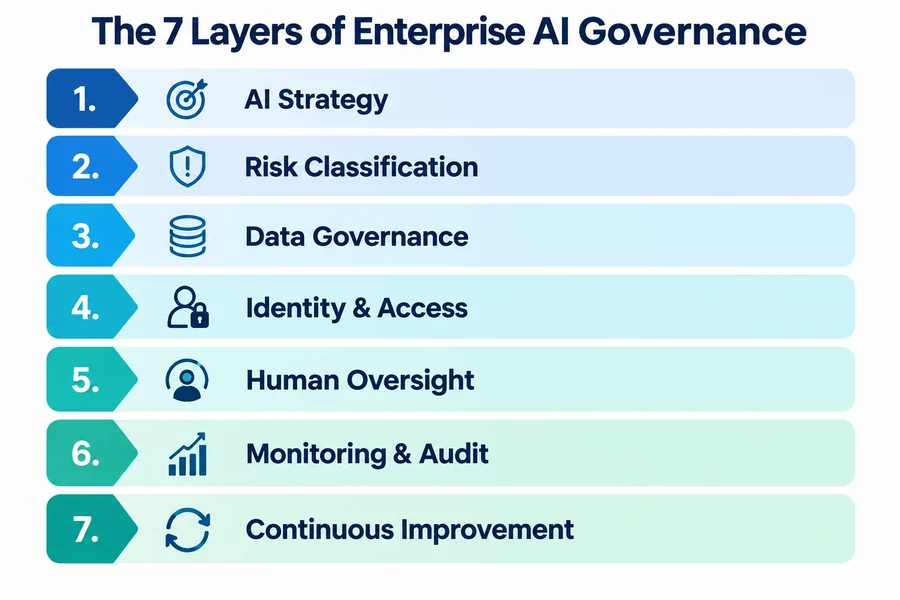
Before an organization can govern AI, it needs to know where AI exists.
Create an inventory covering the AI system, owner, business purpose, model/provider, data accessed, risk level, actions, human approval requirements, monitoring and assessment date.
This becomes the foundation of governance.
Not every AI system deserves the same controls.
Low-risk examples include marketing brainstorming, internal summarization and meeting notes.
Medium-risk examples include customer support recommendations, document classification, business analytics and code generation.
Higher-risk examples can include financial decisions, employment decisions, healthcare-related decisions, credit decisions and autonomous business transactions.
The principle is straightforward: higher potential impact requires stronger controls.
AI governance and data governance are closely connected.
An AI application should not automatically receive access to every database simply because the AI technically can connect to it.
Use least privilege: provide only the permissions required for the specific task. This is particularly important for enterprise agents interacting with ERP, CRM, financial systems and internal APIs.
The goal isn't necessarily to require a human to approve every AI action. Instead, define approval thresholds.
Low-impact actions can be automated. Medium-impact actions can be logged and monitored. High-impact actions can require human approval.
For example, updating an internal classification might be automatic, creating a support ticket might be automatic, while a large refund or financial configuration change could require human approval.
Traditional application monitoring checks servers, APIs and databases. AI systems require additional monitoring of model and agent behavior.
Organizations should consider whether outputs remain accurate, whether hallucinations increase, whether the AI accesses unexpected data, whether agents repeatedly fail, whether tool usage is unusual, whether unauthorized actions are attempted, and whether model or prompt changes affect performance.
If an AI system makes an important decision or performs an important action, organizations should be able to reconstruct what happened.
A useful audit trail can capture timestamp, AI system, user, request, model version, relevant data sources, decision/output, tools called, actions taken, approval status and final result.
For agentic AI, logging tool calls is particularly important.
AI governance cannot stop at development.
AI systems can change because models, prompts, data, retrieval sources, tools, policies or vendors change.
Therefore, organizations need evaluation throughout the AI lifecycle: identify, assess risk, design, test, approve, deploy, monitor, review, improve or retire.
AI governance and cybersecurity cannot be separated.
Modern AI applications introduce concerns such as prompt injection, sensitive information disclosure, insecure tool use, excessive agent permissions, malicious instructions in retrieved content, data poisoning, model manipulation and supply-chain risks.
For agentic systems, the security boundary extends beyond the model to the application, agent, model, tools, APIs and business systems.
Businesses don't need to treat every framework as a separate project.
ISO/IEC 42001 provides requirements for establishing, implementing, maintaining and continually improving an Artificial Intelligence Management System.
NIST AI RMF provides a voluntary framework for managing AI risks, commonly represented through Govern, Map, Measure and Manage. NIST also provides a Generative AI Profile and continues work on updates and additional profiles.
These frameworks can provide structure for enterprise AI governance.
AI governance is increasingly connected to regulatory obligations.
The EU AI Act follows a risk-based approach and introduces requirements depending on the type and risk level of an AI system. Important transparency obligations became applicable on August 2, 2026.
Organizations developing or deploying AI for European users, customers or operations should understand whether the regulation applies to their systems and what obligations may follow.
Organizations don't only need to govern AI they build themselves. They also need to understand AI embedded in third-party products.
For significant AI vendors, consider where data is processed, whether customer data is used for training, retention, security controls, model-change processes, auditability, incident response, subprocessors and contractual protections.
A mature AI governance program should have clearly defined ownership.
Executive leadership defines business objectives and acceptable risk. Technology owns architecture and lifecycle management. Security manages security threats and controls. Legal and compliance evaluate obligations. Product and operations monitor real-world performance and business impact.
Governance works best when it is cross-functional rather than delegated entirely to IT.
Think about governance as a control plane around AI applications.
The governance layer can include policies, risk, compliance, audit, identity, access, monitoring, model evaluation and human approval. Under it sit AI applications, models and agents that interact with enterprise systems such as ERP, CRM and APIs.
Governance should be part of the architecture rather than a post-deployment add-on.
           AI GOVERNANCE
                │
┌───────────────┼────────────────┐
│               │                │
Business       Risk           Technology
Policies    Management        Controls
│               │                │
└───────────────┼────────────────┘
                │
         AI Applications
                │
   ┌────────────┼────────────┐
   ▼            ▼            ▼
GenAI        AI Models    AI Agents
   │            │            │
   └────────────┼────────────┘
                ▼
          Business Outcomes
       User Request
             │
             ▼
       ┌───────────┐
       │ AI Agent  │
       └─────┬─────┘
             │
┌────────────┼────────────┐
▼            ▼            ▼
CRM         ERP          APIs
│            │            │
└────────────┼────────────┘
             ▼
       Business Action
                   AI GOVERNANCE
┌─────────────────────────────────────────────┐
│    Policies • Risk • Compliance • Audit     │
│       Identity • Access • Monitoring        │
│     Model Evaluation • Human Approval       │
└──────────────────────┬──────────────────────┘
                       │
               ┌───────▼────────┐
               │  AI PLATFORM   │
               └───────┬────────┘
                       │
         ┌─────────────┼──────────────┐
         ▼             ▼              ▼
     GenAI Apps     AI Models     AI Agents
         │             │              │
         └─────────────┼──────────────┘
                       ▼
             Enterprise Systems
         ┌─────────────┼────────────┐
         ▼             ▼            ▼
        ERP           CRM          APIs
A practical enterprise policy can define:
The policy should translate into practical controls that employees, engineers and business owners can actually follow.
1. Creating a policy nobody implements.
2. Treating every AI system the same.
3. Giving agents excessive permissions.
4. Ignoring third-party AI.
5. Operating without an audit trail.
6. Treating governance as a one-time certification.
7. Blocking AI instead of governing it.
Good governance should create safe, repeatable ways to adopt AI rather than simply prohibiting it.
Before deploying an important AI system, ask:
What problem does it solve? What happens if it is wrong? Is AI actually necessary?
What data does it access? Is sensitive data involved? Where is data processed? How long is it retained?
What permissions does the AI have? Can it execute actions? Are credentials scoped? Can prompt injection affect tool usage?
Which model is used? How is performance evaluated? What happens after model updates? Are hallucinations measured?
Who owns the system? What risk category does it have? Is human approval required? Is there an audit trail?
Is the AI monitored? Can it be disabled quickly? How are incidents handled? How is the system periodically reviewed?
The next stage of enterprise AI architecture may look less like isolated AI applications and more like a governed AI platform.
Instead of every application independently managing models, permissions, monitoring, policies, logging and evaluations, organizations may increasingly centralize these capabilities.
This creates an AI control plane that can enforce policies, identity, permissions, model gateways, evaluation, monitoring, audit and risk controls across AI applications and agents.
AI governance is sometimes presented as a compliance cost. That is too narrow.
Good governance can enable faster AI adoption because organizations know what is allowed, which tools are approved, what data can be used, which use cases require review, which actions require approval and how AI performance is measured.
Governance can therefore become an AI scaling mechanism rather than simply a brake on AI.
AI is moving from a tool employees use to a capability businesses increasingly depend on.
For generative AI, that means managing data, accuracy, security, transparency and human oversight.
For agentic AI, the challenge becomes greater because AI systems can increasingly interact with enterprise systems and perform actions.
Frameworks such as ISO/IEC 42001 and NIST AI RMF, together with applicable regulations such as the EU AI Act, provide useful foundations for a structured governance approach.
But governance should not remain a document sitting in a compliance folder. It needs to become part of how AI systems are designed, developed, deployed, monitored and retired.
The organizations that get this right will not simply be experimenting with AI. They will have the infrastructure, controls and confidence to scale it.
Space Stem can help evaluate AI use cases, architecture, integration requirements, security considerations and governance controls to build a practical path from AI experimentation to production.
The goal isn't to slow AI adoption.
It is to make AI adoption safe enough to scale.
