


-
 uk
-
 canada
-
 india
uk
canada
india
How model routing, cascades and task-aware inference can improve enterprise AI cost, latency, privacy and reliability
For the first wave of generative AI projects, the architecture decision often sounded simple: choose a capable large language model, connect it to the application, and send user requests to it. That pattern is easy to prototype. It is not always a sensible production architecture.
Enterprise workloads are not uniform. Classifying a support ticket, extracting a known field from an invoice, summarising a short note, reconciling a complex exception and reasoning across business rules are different computational tasks. Sending all of them to the same frontier model can waste inference capacity, increase response time and create an unnecessarily expensive dependency.
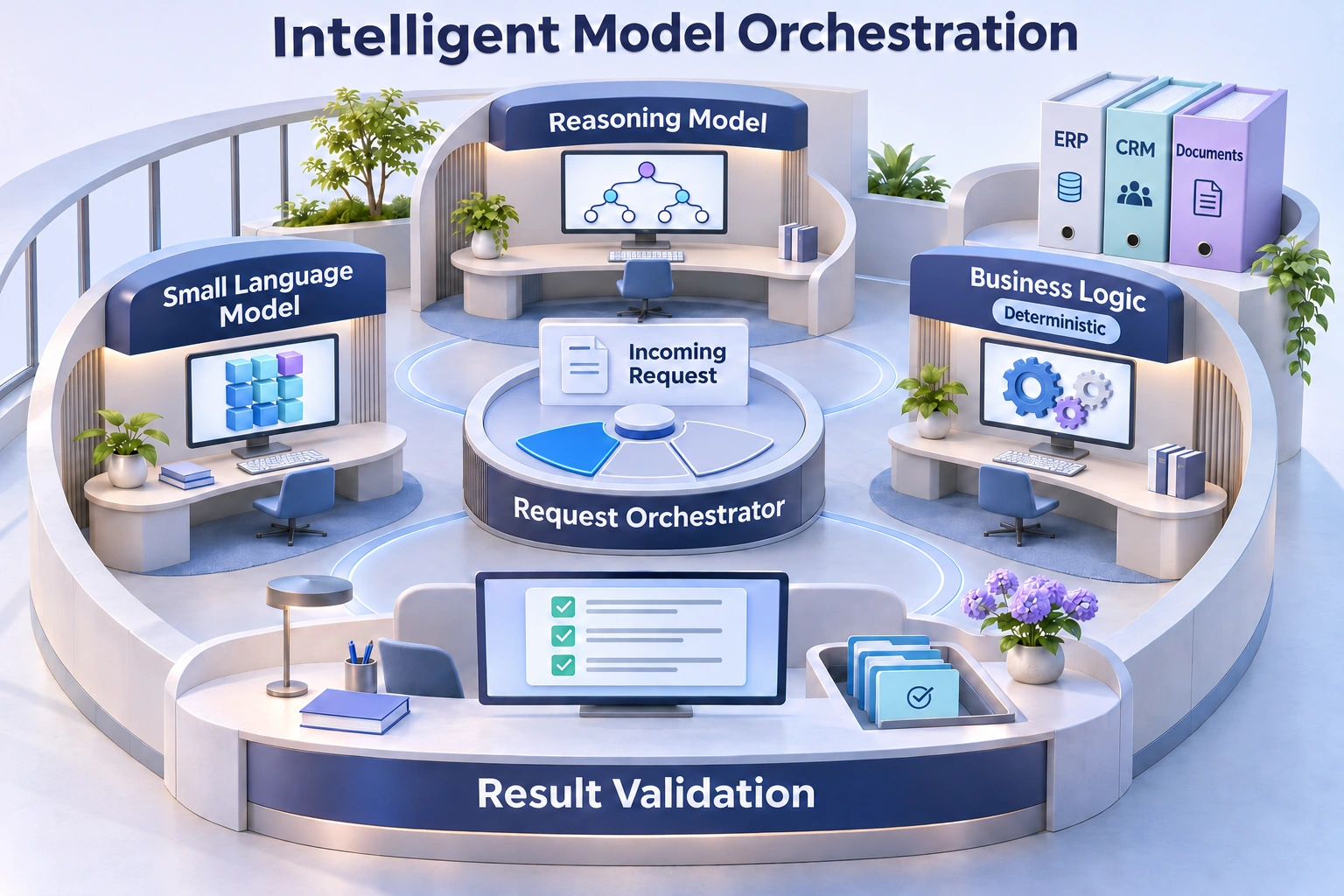
A more mature design uses a portfolio of models. Small language models (SLMs), specialist or deterministic models, and larger reasoning models each handle tasks they are suited to. A routing layer evaluates the request, selects the least expensive eligible model, checks the result, and escalates when uncertainty or risk justifies it.
This is not simply a cost-cutting technique. It is an architectural shift from model-centric applications to workload-aware inference systems. The hard part is defining task classes, measuring quality, routing safely, managing fallbacks and continuously evaluating the complete system.
The 30 October 2026 InfoQ AI, ML and Data Engineering Trends Report identifies a shift toward small language models, reasoning models and inference optimisation. It also highlights the increasing importance of evaluation as organisations move from isolated assistants to agents used by teams and across companies.
The EMNLP 2026 Industry Track paper on HyDRA describes a routing architecture that predicts the capability a request requires—such as reasoning, code generation, debugging or tool use—and selects a cost-effective model from a heterogeneous pool. Its reported production evaluation illustrates why routing is becoming a systems problem, not just a prompt-engineering trick.
At ICLR 2026, the Cascadia work examined joint optimisation of model routing and serving resources. Its results underline a second point: routing policy and inference infrastructure cannot always be designed independently. Model selection should be a runtime decision supported by evaluation data, operational constraints and business risk—not a one-time choice made during a proof of concept.
Imagine an enterprise application that receives 20,000 requests per day. Many are repetitive and narrow: identify an order number, classify a query, extract a delivery date, or route a ticket. A smaller share require synthesis across several records, interpretation of ambiguous policy, or multi-step reasoning.
If every request goes to the same large model, the system pays for capability it does not consistently need. Longer prompts and demanding reasoning requests may also compete with straightforward tasks for the same inference resources. The opposite extreme—replacing the large model with a small model everywhere—can increase misclassification, missed exceptions and unsupported conclusions.
The target is not the smallest possible model. It is the smallest model that meets the quality, safety and latency requirements for a particular task.
| Component class | Good-fit workloads | Role |
|---|---|---|
| Rules and conventional code | Format checks, calculations, thresholds, deterministic routing. | Use when the problem is explicit and deterministic. |
| Specialist classifier / encoder | Intent, language detection, similarity, anomaly signals. | Fast, narrow capability. |
| Small language model | Structured extraction, short summaries, routine classification, constrained drafting. | Lower-cost language capability for bounded tasks. |
| General-purpose large model | Broad synthesis, ambiguous language, varied content. | Wider language competence. |
| Reasoning model | Multi-step analysis, complex exceptions, competing constraints. | Escalation for tasks requiring deeper reasoning. |
These are functional categories, not rigid product labels. Model size alone does not determine capability; specialist models may outperform larger general-purpose models on target tasks. Evaluate the versions and deployment configurations you intend to use.
Model routing is the runtime mechanism that decides which model or execution path should handle a request. A router can use rules, metadata, lightweight classifiers, semantic features, evaluation results, workload state or a combination of signals.
A production router should not merely ask whether a prompt is easy or hard. It should ask what capability the task requires, what quality threshold applies, what an error would cost, and which available execution path can meet the service objective.
The router itself becomes production software. It needs versioning, tests, monitoring and rollback like any other critical middleware component.
A model cascade first processes a request with a lower-cost model and escalates to a more capable model if the result does not meet a defined acceptance condition. Unlike one-time routing, a cascade uses the outcome of an earlier stage to decide whether more computation is justified.
For example, a small model extracts invoice fields. Deterministic validation checks invoice number, supplier, date, tax and total against expected formats and ERP records. If extraction passes, the workflow continues. If key fields conflict or evidence is insufficient, the request is escalated to a larger model or a human reviewer.
Do not rely solely on a model saying it is confident. Use observable signals: validation failures, disagreement between independent methods, retrieval evidence, known task difficulty, out-of-distribution detection and measured error rates. A cascade is only as safe as the gate that decides whether to accept or escalate.
The cheapest model per token is not necessarily the cheapest way to complete a business task. A smaller model may require retries, produce incomplete output, consume additional validation calls or send more cases to manual review. A larger model may cost more per call but complete a difficult task in one pass.
A useful operational measure is cost per successfully completed task, not cost per generated token. Include input/output charges, routing overhead, retrieval, validation, retries, human review, infrastructure and downstream mistakes.
| Metric | What it tells you | Why it matters |
|---|---|---|
| Cost per successful task | Total system cost / tasks completed to standard. | Compares real workflow economics. |
| Escalation rate | Share passed to stronger model or human. | Shows whether first route is appropriate. |
| First-pass acceptance | Share accepted without retry or escalation. | Measures first-stage efficiency. |
| End-to-end latency | Time to verified outcome. | Reflects workflow experience. |
| Error / rework rate | Incorrect outputs, corrections and manual rework. | Captures hidden quality costs. |
| Quality by task class | Measured success against labelled cases. | Prevents aggregate metrics hiding weak categories. |
Establish a baseline by task class, then compare the hybrid design using the same representative workload and acceptance criteria.
A multi-model design can reduce latency for simple tasks, but can also make latency worse if the router adds unnecessary calls or a cascade serially invokes several models. Design around end-to-end service-level objectives.
Measure request parsing, routing, queueing, time-to-first-token, generation, validation, tool execution and escalation. A small model that responds quickly but frequently triggers a second model may not improve completion time.
SLMs can be easier to deploy close to the data they process, including within a private cloud, controlled network or edge environment. This can be attractive for customer records and commercial documents. But a smaller model is not automatically private or secure. Prompt construction, logs, telemetry, retrieval, caches, evaluation datasets and human review tools may all process sensitive content.
A router cannot make good decisions if the organisation does not know how each model performs on its actual workload. Public benchmarks are useful for initial screening, but production selection requires a task-specific evaluation set drawn from representative business cases.
Include routine requests, ambiguous cases, edge cases, malformed inputs, multilingual content, adversarial instructions and examples where the correct answer is to abstain or escalate.
Judge the router on the quality and cost of the complete system, not whether its classifier predicts the same model choice as a human reviewer.
Keep business rules and access control outside the model. The model can interpret and propose; deterministic services should enforce permissions, financial limits, state transitions and other invariants.
A finance team receives supplier invoices through email and a document portal. The workflow extracts fields, matches suppliers, compares purchase orders, detects exceptions and prepares an approval package.
| Stage | Execution path | Acceptance / escalation |
|---|---|---|
| Document classification | Lightweight classifier or SLM. | Unknown formats go to review. |
| Field extraction | SLM with structured output. | Validate required fields and source evidence. |
| Arithmetic and identifiers | Deterministic code and ERP lookups. | Reconcile totals, tax, currency, supplier and PO. |
| Approval decision | Existing finance policy/workflow. | Model cannot approve payment or override thresholds. |
| Audit | Application event log and trace. | Record source, route, validation, reviewer and final state. |
This architecture reserves expensive reasoning for exceptions that genuinely need it. Most routine extraction and reconciliation can follow predictable paths. A model does not become the authority for payment approval simply because it can explain an invoice discrepancy.
Baseline the workload: Measure current model quality, latency, cost, escalation and rework by task class.
Identify deterministic work: Move calculations, validation, permission checks and fixed transformations into code where appropriate.
Select one bounded SLM use case: Choose a repetitive task with measurable outcomes, such as ticket classification or invoice extraction.
Build an evaluation set: Include routine, ambiguous, edge and adversarial examples; agree acceptance thresholds.
Introduce a simple router: Start with explicit rules and approved model eligibility; avoid complex learned routing until justified.
Add controlled escalation: Use a stronger model or human reviewer when validation fails, risk is high or task is outside tested limits.
Run shadow and canary tests: Compare against the existing workflow before consequential production actions.
Optimize business outcomes: Track cost per successful task, quality, latency, rework and user experience.
The next stage of enterprise AI will not be defined only by which model tops a benchmark. It will be defined by how effectively organisations combine models, conventional software, data services and human judgement to complete real work.
SLMs are valuable when a task is bounded and their performance is proven. Larger reasoning models are valuable when complexity justifies their cost. Deterministic code remains the right choice for calculations, permissions and business invariants. A routing and evaluation layer connects these components into one accountable system.
The engineering challenge is to make the decision measurable: which route was chosen, why it was eligible, whether the result passed validation, what it cost and whether the business task was completed correctly.


