AI applications are moving from experiments and copilots into real business workflows. They are summarizing documents, answering customers, retrieving enterprise knowledge, generating recommendations, calling APIs and increasingly taking actions through agents.
That changes the engineering problem. Traditional application monitoring can tell a team that an API returned a 500 error, a database query became slow or a server ran out of memory. It does not necessarily explain why an AI assistant produced a poor answer, why retrieval returned the wrong documents, why an agent selected an unexpected tool, or why the same workflow behaved differently after a model or prompt change.
AI observability is the discipline of making those behaviors measurable and traceable in production. It connects technical telemetry with AI-specific signals such as prompts, model versions, retrieved context, tool calls, evaluation scores, latency, token usage, cost, safety events and user feedback.
NIST notes that post-deployment monitoring matters because real-world AI systems can produce unforeseen outputs due to non-determinism and changing inputs. Gartner reported in May 2026 that 40% of organizations deploying AI are expected to implement dedicated AI observability tools by 2028.
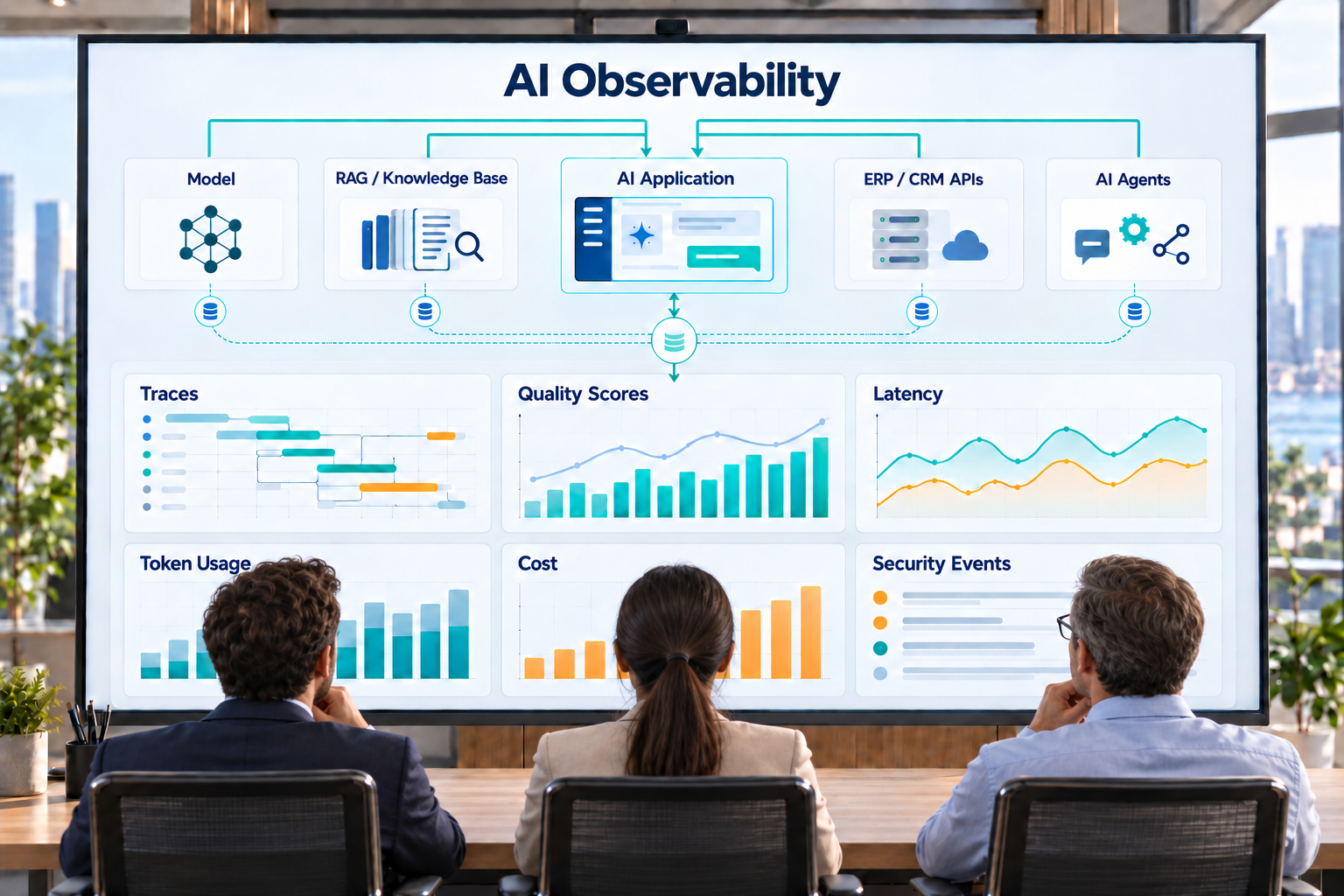
AI observability is the ability to understand the internal behavior and operational performance of an AI-enabled application from the telemetry it produces. It extends conventional logs, metrics and traces with AI-specific information.
| Layer | What to observe | Example signal |
|---|---|---|
| Application | Requests, errors, latency, dependencies | API latency increased |
| Model | Model/version, response latency, failures | Model version changed |
| Prompt & context | Prompt template, context size, variables | Unexpected context length |
| RAG | Queries, retrieved documents, relevance | Low retrieval relevance |
| Agent | Tools, actions, workflow state | Unexpected tool selected |
| Quality | Evaluation scores, corrections, feedback | Answer quality declined |
| Cost | Tokens, calls, provider/model cost | Cost per workflow increased |
| Security & policy | Sensitive data, violations, access | Restricted data accessed |
Conventional applications generally follow relatively deterministic paths. AI applications introduce probabilistic behavior and additional layers of context.
| Traditional question | AI-specific question |
|---|---|
| Did the request fail? | Did the AI produce an acceptable outcome? |
| How long did the API take? | Which step caused the latency: retrieval, model, tool or orchestration? |
| Which endpoint failed? | Which model, prompt, context or tool contributed to the failure? |
| Was the service available? | Was the service available and was the answer useful? |
| What error occurred? | Why did the model generate this response? |
AI observability should therefore sit alongside, rather than replace, standard application and infrastructure observability.

Track model/provider, model version, latency, timeout rate, error rate, output characteristics and changes in quality after model updates. If multiple models are used, model-level comparison helps identify regressions and routing problems.
Prompt templates are part of the application. Track template versions, context size, truncation, missing variables and significant prompt changes. A prompt change can alter behavior even when application code has not changed.
For retrieval-augmented generation, tracing should make it possible to see the query, retrieval strategy, documents or chunks selected, metadata filters, ranking information where available, context passed to the model and the final answer.
Useful RAG metrics include retrieval latency, retrieval failure rate, relevance, context completeness and groundedness. These should be evaluated against the business use case rather than treated as universal numbers.
Agents add another dimension because the system may choose tools and actions dynamically. An agent trace should show which tools were invoked, what inputs were supplied, whether an action succeeded, how long it took and whether the action required approval.
AI cost should be measured at the workflow level, not only at infrastructure level. Track tokens, model calls, retrieval operations and external tool usage.
A central mistake is to treat latency and uptime as the definition of AI quality. An AI system can be fast, available and technically error-free while still producing poor business outcomes.
| Metric category | Examples |
|---|---|
| Correctness | Answer accuracy, task success, factual correctness |
| Grounding | Evidence alignment, citation correctness, unsupported claims |
| Relevance | Retrieved context relevance, answer relevance |
| Consistency | Behavior across comparable inputs |
| Safety | Policy violations, unsafe outputs, sensitive-data exposure |
| Human feedback | Corrections, ratings, escalation frequency |
| Business outcome | Resolution rate, conversion, processing time, manual effort saved |
| AI evaluation | AI observability |
|---|---|
| Tests expected behavior | Shows production behavior |
| Uses curated datasets | Uses real production telemetry under appropriate controls |
| Supports release decisions | Supports incident investigation and improvement |
| Measures predefined scenarios | Detects unexpected behavior and drift |
| Controlled testing | Production operations |
The strongest approach uses both. Evaluation creates a quality baseline; observability detects deviations from that baseline once real users and enterprise data enter the system.
Reference architecture:
USERS
  │
  ▼
AI APPLICATION
  │
  ▼
AI ORCHESTRATOR
  ├──► RAG / KNOWLEDGE LAYER
  ├──► MODEL GATEWAY
  └──► TOOLS / ERP / CRM / APIs
                 │
                 ▼
        AI OBSERVABILITY LAYER
        ├─ Logs
        ├─ Metrics
        ├─ Traces
        ├─ Evaluations
        ├─ Cost
        ├─ Quality
        └─ Security / Policy Events
                 │
                 ▼
          OPERATIONS DASHBOARD
          ├─ Alerts
          ├─ Analytics
└─ Human ReviewFor a simple chatbot, a request and response may be enough. For enterprise RAG or agentic applications, the trace becomes much more valuable.
Consider a customer-service agent that receives a request, searches the knowledge base, retrieves documents, calls the CRM, checks an order status, invokes a refund API and then generates a response. If the customer receives an incorrect answer, looking only at the final response is not enough.
A useful trace should connect the complete workflow so engineers can determine whether the problem originated in retrieval, model interpretation, tool execution, business-system data or final generation.
Governance and observability solve different problems, but they reinforce each other.
| Governance asks | Observability answers |
|---|---|
| What should the agent be allowed to access? | What data did it actually access? |
| Which models are approved? | Which model/version actually executed? |
| Which actions require approval? | Was approval requested and recorded? |
| What must be logged? | Is the required audit trail complete? |
| What data must not leave the system? | Was sensitive data transmitted or exposed? |
NIST's Generative AI Profile frames AI risk management across the lifecycle and emphasizes governing, mapping, measuring and managing AI risks.
AI observability can create a new security problem if implemented carelessly. Prompts and responses may contain customer records, financial information, credentials, internal documents or other sensitive data.
The goal is useful visibility, not indiscriminate data collection.
Imagine an internal ERP assistant that answers questions about orders and inventory. Infrastructure dashboards show high availability, normal CPU usage and stable API latency. The application appears healthy.
Users, however, report that answers have become less accurate.
AI observability might reveal that a recent knowledge-base update changed chunking and retrieval behavior. The model is still responding successfully, but the retrieved context is less relevant. Traditional infrastructure monitoring would not necessarily identify the problem.
With trace-level RAG observability, the engineering team can compare retrieval quality before and after the change, identify affected documents and validate the fix using an evaluation dataset.
AI systems can therefore fail semantically even when they are operationally healthy.
| Area | Minimum capability |
|---|---|
| Application | Logs, errors, latency and dependency traces |
| Model | Model/provider/version tracking |
| Prompt | Template/version and context metadata |
| RAG | Retrieval traces and relevance evaluation |
| Agents | Tool-call and action traces |
| Quality | Evaluation metrics and human feedback |
| Cost | Token and workflow-level cost tracking |
| Security | Policy events, access and sensitive-data controls |
| Operations | Alerts, dashboards and incident ownership |
| Governance | Auditability and evidence of control effectiveness |
As AI moves into core business workflows, observability should not be treated as an optional dashboard added after deployment. It belongs in the architecture.
This is particularly important for systems that connect AI with ERP, CRM, e-commerce, document management, customer portals and internal APIs. The more systems an AI workflow can read or change, the more valuable end-to-end traceability becomes.
The emerging enterprise pattern combines application observability, AI telemetry, evaluation, security, governance and business outcome measurement in one operational model.
A technical trace can explain one request, but a dashboard helps teams identify patterns across thousands of requests.
This is where observability and real-time business dashboards converge: the objective is to turn high-volume telemetry into operational decisions.
AI observability changes the engineering workflow. Developers need to think beyond whether code executes successfully and ask whether the AI system behaves correctly under real-world conditions.
AI applications are different from conventional software because behavior depends not only on code and infrastructure, but also on models, prompts, context, retrieved information, data quality, tool selection and changing real-world inputs.
That makes observability a foundational capability.
AI observability is not simply adding more dashboards to an AI application. It is creating the ability to understand, measure, debug and improve AI behavior in production.
For enterprises, the practical goal is straightforward: know what the AI system did, understand why it did it, measure whether the result was acceptable, and have a controlled way to respond when it is not.
Building an AI application is only the first step. Making it reliable, measurable and operationally trustworthy requires the right architecture, integrations, monitoring and governance.
If your business is exploring AI-powered applications, intelligent automation or AI integration with existing enterprise systems, Space Stem can help you design and build the right technical foundation.
Talk to our team about your AI application or enterprise automation requirements.
