


-
 uk
-
 canada
-
 india
uk
canada
india
The AI industry has spent years asking a familiar question: Which model should we use?
That question still matters. But for enterprise AI, another question is becoming harder — and arguably more important: What information should the AI see when it has to make a decision?
An enterprise agent may have access to thousands of documents, customer records, ERP transactions, policies, APIs, previous interactions, operational data and tool definitions. Giving the model access to all of that does not automatically make it more intelligent. In many cases, it makes the system less reliable, more expensive and harder to control.
This is where context engineering enters the architecture.
Context engineering is the deliberate design of the information supplied to an AI model at each step of an application or agent workflow. It includes instructions, retrieved evidence, business state, conversation history, memory, tool definitions, permissions and other information that influences the model's next decision.
Anthropic describes context engineering as the broader evolution of prompt engineering. Gartner's September 2026 research similarly argues that enterprise context layers are necessary to scale agentic AI with trusted business context.
For Space Stem's enterprise software audience, this is an important architectural shift. The next generation of AI applications will not be built around an LLM alone. They will be built around a controlled context layer connecting AI to the company's actual systems, data and business processes.

Prompt engineering focuses primarily on instructions. Context engineering asks a larger question: what complete information state should the model receive at the moment it makes a decision?
| Prompt engineering | Context engineering |
|---|---|
| Optimises instructions | Optimises the complete information state |
| Mostly prompt-centric | Prompt + data + memory + tools + state + permissions |
| Often designed once | Continuously assembled at runtime |
| Focuses on wording | Focuses on relevance, provenance, freshness and budget |
| Useful for isolated tasks | Critical for multi-step enterprise workflows |
A well-written prompt cannot compensate for missing business context. An excellent model cannot reliably answer a question when the required information was never supplied, came from the wrong source, or lacked the business rules needed to interpret it.
| Context component | Purpose | Enterprise example |
|---|---|---|
| Instructions | Define behaviour | Customer-service policy |
| User/task state | Explain current objective | Customer requests order cancellation |
| Retrieved evidence | Provide knowledge | Product policy and order record |
| Business state | Reflect current reality | Order status = dispatched |
| Memory | Preserve useful history | Previous customer interaction |
| Tool definitions | Describe available actions | CRM lookup / refund API |
| Permissions | Constrain access/actions | Refund above threshold requires approval |
| Temporal context | Explain what is current | Pricing valid from 1 Oct 2026 |
The architecture challenge is deciding which information should be present, at what level of detail, and at which point in the workflow.
A useful mental model is to treat context as an intermediate architecture layer between enterprise systems and AI models.
ENTERPRISE SYSTEMS
ERP ─ CRM ─ E-commerce ─ Documents ─ APIs ─ Data Platforms
                         │
                         ▼
                ENTERPRISE CONTEXT LAYER
        ┌────────────────────────────────────┐
        │ Retrieval                          │
        │ Business State                     │
        │ Context Policies                   │
        │ Memory                             │
        │ Permissions                        │
        │ Provenance & Freshness             │
        │ Context Budgeting                  │
        └─────────────────┬──────────────────┘
                          │
                          ▼
                 AI ORCHESTRATION
                  /      |       \
                 ▼       ▼        ▼
              MODEL    TOOLS    AGENT STATE
                          │
                          ▼
                   BUSINESS ACTION
Enterprise systems remain the systems of record. The context layer determines what subset of enterprise reality should be made available to AI for a particular decision. Gartner and Forrester research in 2026 increasingly frames this as an enterprise architecture capability.
A common assumption is that AI becomes better when we provide more information. In enterprise systems, that assumption can be dangerous. A procurement agent receiving hundreds of pages of policy, years of history and dozens of supplier records may have more information but a worse signal-to-noise ratio.
Anthropic describes context as a finite resource and highlights context rot: model performance can degrade as irrelevant information accumulates. The practical engineering principle is therefore not maximum context; it is maximum useful context.
| Approach | Likely result |
|---|---|
| Send everything | High token cost, noise and confusion |
| Fixed top-k retrieval | Simple, but can miss task-specific evidence |
| Dynamic retrieval | More relevant, but needs strong retrieval logic |
| Progressive disclosure | Load information as the agent discovers the need |
| Hybrid context | Combine persistent high-value context with just-in-time retrieval |
| Dimension | Question | Failure example |
|---|---|---|
| Relevance | Is this useful for the current task? | Old catalogue used in refund decision |
| Freshness | Is it current enough? | Agent uses stale inventory |
| Provenance | Where did it come from? | Draft policy treated as approved |
| Access | Is the agent authorised to use it? | Restricted customer data exposed |
A fifth dimension is budget. Every piece of context consumes tokens, latency, model attention and money. Context therefore needs an economic model as well as a technical model.
RAG solved an important problem: retrieve enterprise knowledge at runtime instead of expecting the model to know every internal fact. But a vector database is not automatically a context architecture.
| Pattern | How it works | Best suited for |
|---|---|---|
| Static / eager | Load important context before reasoning | Small stable policies |
| Retrieval-based | Retrieve evidence before generation | Knowledge-heavy Q&A |
| Just-in-time | Retrieve when the agent discovers the need | Long workflows |
| Tool-based | Query live systems | ERP, CRM, inventory |
| Progressive disclosure | Reveal information in stages | Complex investigations |
Anthropic highlights just-in-time retrieval and progressive disclosure for long-running agents, while noting the latency and engineering trade-offs.
Agents make context engineering harder because context changes after every meaningful action. An order agent may begin with a customer request, retrieve an order, discover a delivery issue, call a shipping API, receive a new status and then decide whether a refund is allowed.
This is very different from sending a long conversation history into every model call.
| Memory | Context |
|---|---|
| Persists information across interactions | Represents what is relevant right now |
| May be long-lived | Usually task-specific |
| Stores historical state | Selects information for the current decision |
| One source of information | Can combine many sources at runtime |
A common mistake is to keep adding information to long-term memory and inject it into every request. Good context engineering decides what memory is useful now and retrieves only that subset.
Enterprise AI needs more than information; it needs information with lineage. If an approved policy says refunds are allowed within 30 days while an obsolete draft says 60 days, the context should expose approval status, version and effective date rather than presenting both as equivalent facts.
Context provenance is therefore not just a data-engineering concern. It directly affects AI reliability.
| Type | Example | Typical strategy |
|---|---|---|
| Knowledge | Refund policy | Document retrieval |
| State | Current order status | Live API / database query |
| Knowledge | Product specifications | Search / RAG |
| State | Available inventory | ERP / inventory API |
| Knowledge | Process guide | Governed document store |
| State | Outstanding balance | Finance/ERP system |
Using RAG to answer a live-state question can be an architectural mistake. The context layer should know when to retrieve a document and when to query the system of record.
Traditional applications enforce database and API authorization. AI systems add another boundary: the information selected for model context.
Prompt instructions can guide behaviour; deterministic software controls should enforce authorization.
Context has a cost.
| Cost | What drives it |
|---|---|
| Model cost | Input and output tokens |
| Latency | Large context and multiple retrieval/tool calls |
| Quality | Noise, contradictions and context dilution |
| Infrastructure | Retrieval, indexing, memory and telemetry |
| Operational complexity | More sources and routing |
For an order-support agent, a strong budget might include a small system policy, current identity and permissions, one live order query, a few relevant policy passages, necessary history and a refund tool definition only if relevant. That can outperform passing the entire customer profile and policy library every time.
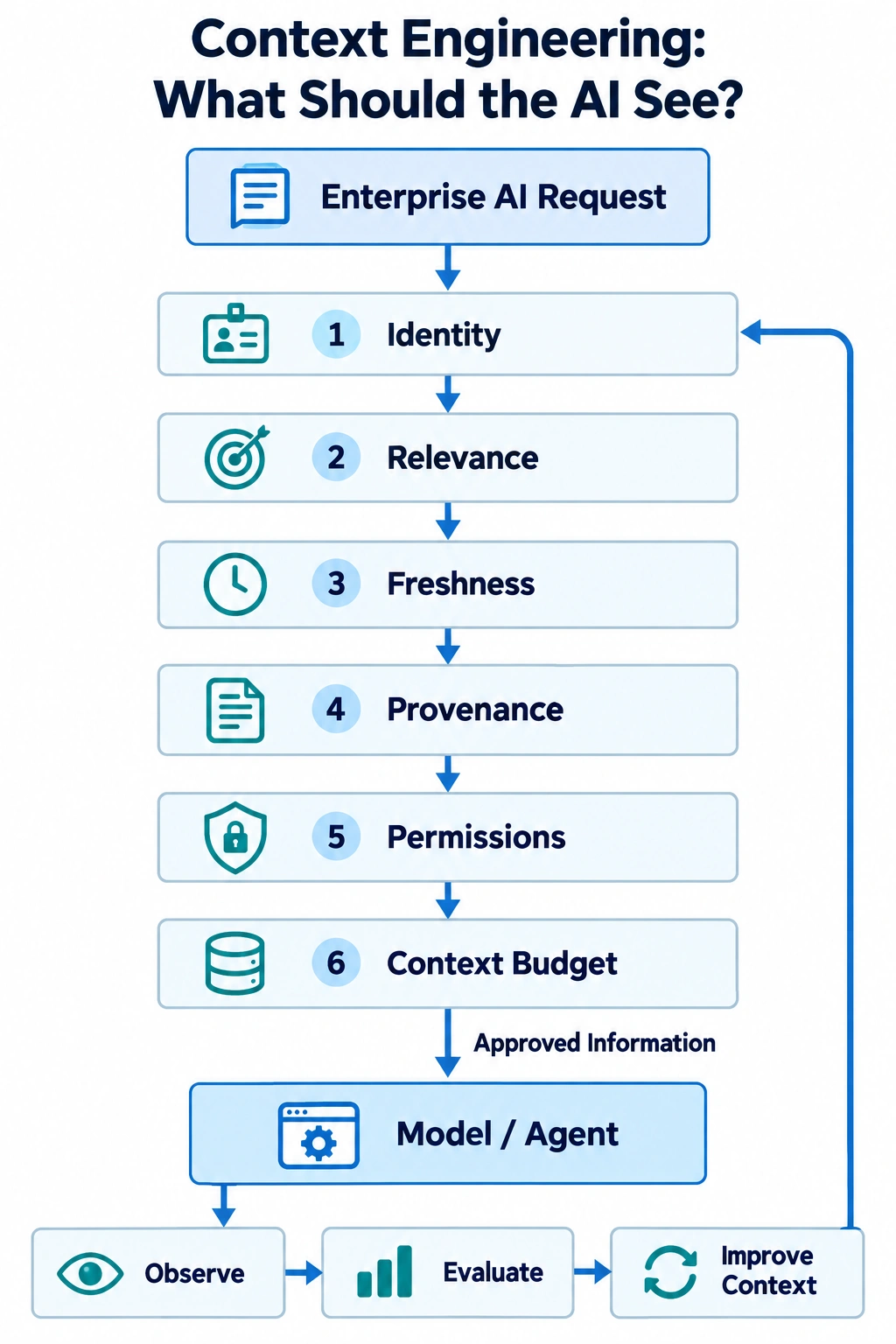
Blog 9 focused on AI observability. Context engineering is one of the areas observability makes measurable.
| Context signal | What observability can reveal |
|---|---|
| Retrieval relevance | Whether selected information was useful |
| Context size | Whether workflows are becoming unnecessarily large |
| Source distribution | Which systems feed the model |
| Freshness | Whether stale information enters decisions |
| Tool calls | When live data was retrieved |
| Context changes | How behaviour changed after context changes |
| Outcome | Whether assembled context produced a successful task |
This creates an engineering loop: design context → observe context → evaluate outcome → improve context.
| Governance policy | Context implementation |
|---|---|
| Approved sources only | Source allowlists and provenance |
| Least privilege | Permission-aware retrieval |
| Sensitive data restrictions | Filtering/redaction before context assembly |
| Approved policies | Version and approval metadata |
| Auditability | Context/source telemetry |
| Retention rules | Controlled memory and storage |
Blog 7 established governance; context engineering gives governance something concrete to govern.
Consider an AI assistant integrated with an e-commerce platform and ERP. A customer asks: “Can I cancel my order and get a full refund?” A weak architecture retrieves a generic refund policy and asks the model to answer.
A stronger context architecture assembles:
Now the model is not guessing from generic knowledge. It is reasoning over a controlled representation of current business state. That distinction is where enterprise AI starts becoming dependable.
If every AI feature independently implements retrieval, permissions, memory, source ranking and context assembly, an enterprise creates a new form of technical debt.
Organizations rarely want every application to implement identity, logging or payments independently. Context is beginning to follow a similar platform pattern.
Businesses may buy a foundation model, AI platform or agent framework. But enterprise context is deeply tied to how the organization actually operates — its data structures, permissions, workflows, policies, terminology and system relationships.
The differentiating engineering layer may increasingly sit above the model: the context architecture connecting the model to proprietary business reality. This does not mean building everything internally; it means deciding which context capabilities are strategic and which can be consumed as platform services.
| Area | Questions to answer |
|---|---|
| Purpose | What decision or task is the AI performing? |
| Sources | Which systems contain required information? |
| Relevance | How do we select only useful information? |
| Freshness | Does information need to be live? |
| Provenance | Can we identify source and version? |
| Security | Is AI authorised to receive it? |
| Memory | What history is genuinely useful? |
| Tools | Which actions/live queries are available? |
| Budget | What is acceptable context/cost/latency? |
| Evaluation | How do we know context produced a good outcome? |
| Observability | Can we see what context influenced the decision? |
The enterprise AI conversation is moving away from model selection alone. The real system includes data, retrieval, memory, tools, permissions, business state, orchestration, context, evaluation and observability.
Gartner, Oracle and Forrester research in 2026 all point toward the same direction: as agents become more capable, organizations need deliberate architecture for supplying trusted, relevant and situational context.
The next generation of enterprise AI will not be won simply by choosing the newest model. It will be won by building systems that give those models the right information at the right moment, from the right source, with the right permissions and enough context to make a useful decision — without overwhelming the model or the budget.
That is the role of context engineering. For organizations building AI agents, RAG applications, intelligent enterprise assistants or AI-powered automation, context should be treated as architecture, not prompt decoration.
The model provides intelligence. The context layer connects that intelligence to the business. And in enterprise AI, that connection is where much of the real engineering value lies.
Reliable enterprise AI depends on more than a powerful model. It depends on how effectively AI can access the right business context, data, systems and workflows.
Space Stem helps businesses design and build AI applications that integrate with existing enterprise software, APIs, ERP, CRM, e-commerce and operational systems.
If you are evaluating an AI assistant, RAG platform, AI agent or intelligent automation workflow, talk to our team about the architecture behind it.


